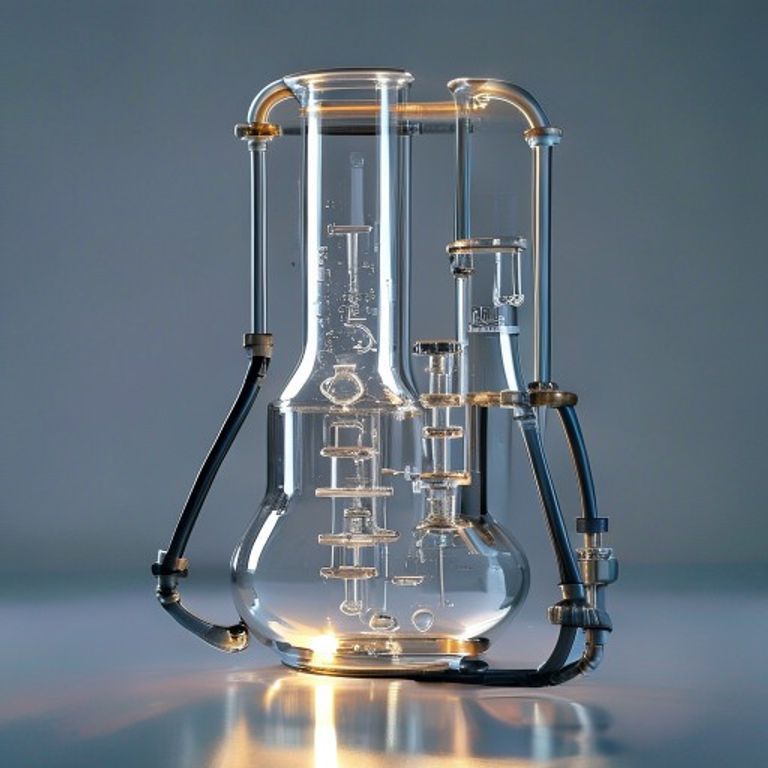
Demystifying the Condenser Apparatus: Your Essential Guide to Lab Success

Demystifying the Condenser Apparatus: Your Essential Guide to Lab Success
Hello, fellow science enthusiasts! Have you ever wondered how chemists manage to recover solvents, purify liquids, or keep reactions simmering without losing precious materials to the air? The secret often lies with a humble yet incredibly vital piece of laboratory glassware: the condenser apparatus. If you’ve ever seen a setup in a chemistry lab with water tubing attached to a glass tube, you’ve likely spotted a condenser in action. Today, we’re going to dive deep into what this amazing tool does, why it’s so crucial, and how to make the most of it in your own experiments.
What Exactly Is a Condenser Apparatus?
At its core, a condenser is a piece of equipment designed to cool hot vapor back into liquid form. Think of it like this: when you see steam rising from a hot cup of tea and it hits a cold window, it turns back into tiny water droplets. A condenser does pretty much the same thing, but in a much more controlled and efficient way within a lab setting. It typically consists of a glass tube with an outer jacket or coils through which a coolant (usually water) flows. This coolant creates a cold surface that the hot vapor encounters, causing it to condense. It’s essentially a sophisticated scientific cooling coil!
Why Do We Need Condensers? The Core Applications
Condensers are not just fancy tubes; they are indispensable in many chemical processes. Let’s look at their two primary applications:
Distillation: Separating Liquids with Precision
Imagine you have a mixture of two liquids with different boiling points, and you want to separate them. This is where understanding physics comes in handy! You heat the mixture, and the liquid with the lower boiling point turns into vapor first. This vapor travels up into the condenser, gets cooled, and turns back into liquid. This newly condensed liquid, now purified, can be collected in a receiving flask, perhaps a well-placed the mighty Erlenmeyer flask. This process is called distillation and is vital for purifying chemicals, making spirits, or even desalinating water.Reflux: Heating without Loss
Sometimes, a chemical reaction needs to be heated for an extended period. If you just heated it in an open flask, your solvent would simply boil away, and you’d lose your precious reactants! A reflux condenser is designed to prevent this. It’s placed vertically above the reaction flask. As the solvent boils, its vapor rises into the condenser, cools, and drips back into the reaction mixture. This means you can heat a reaction at its boiling point for hours without losing any solvent, creating a closed system where everything returns home.
Exploring the Types of Laboratory Condensers
Just like there are different types of wrenches for different nuts, there are several types of laboratory condensers, each suited for specific tasks. Here are a few common ones:
Liebig Condenser: The Workhorse
This is perhaps the most basic and common type. It features a straight inner tube surrounded by a wider outer jacket. Coolant flows through the jacket, providing a long, cool surface for efficient condensation. Its simplicity makes it excellent for general distillation and reflux, and understanding the parts of a Liebig condenser is a great starting point for anyone in the lab.Graham Condenser: The Coil King
Instead of a straight inner tube, the Graham condenser has a coiled inner tube. This increases the surface area for condensation, making it more efficient for situations requiring faster cooling or for handling larger volumes of vapor. However, the coiled design can sometimes make it harder to clean.Allihn Condenser: The Bulbous Beauty
The Allihn condenser (sometimes called a “bulb” condenser) has a series of bulges or indentations along its inner tube. These bulges increase the internal surface area, promoting more vigorous mixing of vapor and providing a larger area for condensation. It’s often favored for reflux setups where maximum contact between vapor and cold surface is desired.Cold Finger Condenser: For Small-Scale Magic
This is a simpler, often smaller condenser, sometimes used for very small-scale distillations or sublimation. It’s essentially a tube (the “finger”) that can be cooled (e.g., with ice or dry ice) and inserted directly into a flask, acting as a cold surface for vapor to condense on.
How Does a Reflux Condenser Work? A Closer Look
Let’s really dig into how a reflux condenser works. Imagine your reaction mixture is boiling in a round-bottom flask. Vapor rises into the vertically mounted condenser. The coolant (typically water) enters the condenser through the lower inlet and exits through the upper outlet. This counter-current flow ensures that the coldest water is encountering the hottest incoming vapor, maximizing cooling efficiency. As the hot vapor travels up the inner tube, it touches the cold inner surface, loses energy, and transforms back into liquid droplets. These droplets then elegantly drip back down into the reaction flask, ensuring no material is lost. It’s a beautiful, continuous cycle that keeps your reaction at a constant temperature without the solvent ever leaving the system.
Choosing the Right Condenser for Your Needs
With so many options, how do you pick the best one? Choosing a water cooled condenser, or any condenser, depends on your specific application:
For Distillation: A Liebig condenser is usually a good, cost-effective choice for many distillations due to its efficient straight path. For very volatile liquids or large-scale distillations, a Graham or Allihn might offer better cooling.
For Reflux: Allihn condensers are often preferred for reflux because their increased internal surface area can handle robust boiling, returning solvent quickly. A Liebig can also work well for less vigorous reflux.
Cooling Capacity: Consider the boiling point of your solvent. Lower boiling points require more efficient cooling. Ensure your water flow is adequate; too slow, and your vapor might escape!
The best condenser for distillation really depends on the scale, the compounds involved, and the desired efficiency. Always match the condenser to the task at hand!
Maintenance and Safety Tips
Taking care of your condenser is crucial for its longevity and your safety:
Cleanliness: Always clean your condenser thoroughly after each use. Residual chemicals can cause contamination or blockages.
Water Flow: Always connect your water hoses correctly – water in at the bottom, out at the top. This ensures the condenser jacket fills completely, maximizing cooling efficiency and preventing air pockets.
Avoid Thermal Shock: Don’t introduce very cold water into a very hot condenser rapidly, as this can cause the glass to crack. Gradual cooling is always best.
Secure Connections: Ensure all hose connections are tight to prevent leaks, which can be messy and dangerous.
Conclusion
The condenser apparatus might seem like a simple piece of glass, but its role in the chemistry lab is anything but. From purifying substances through distillation to facilitating long-duration reactions via reflux, it’s an indispensable tool that enables countless experiments and discoveries. Understanding its principles, knowing the different types, and using them safely will undoubtedly elevate your lab success. So, next time you see one, you’ll know you’re looking at a true unsung hero of the scientific world!
FAQ
Q1: Can I use a condenser without a water supply?
A1: Generally, no. Most laboratory condensers rely on a continuous flow of a coolant, usually water, to be effective. Without it, they wouldn’t provide sufficient cooling, and vapor would escape or not condense properly.
Q2: What’s the difference between a condenser for distillation and one for reflux?
A2: While many condensers can be used for both, condensers for distillation are typically oriented downwards to collect the condensed liquid. For reflux, the condenser is mounted vertically above the reaction flask, allowing the condensed liquid to drip back into the flask.
Q3: How do I know if my condenser is working effectively?
A3: You should observe vapor condensing within the inner tube and dripping back (for reflux) or into the receiving flask (for distillation). The outer jacket of a water-cooled condenser should feel cool to the touch. If vapor is escaping from the top, your cooling might be insufficient, or the flow rate is too low.
Q4: Are all condensers made of glass?
A4: Most laboratory condensers are indeed made of borosilicate glass due to its heat resistance and chemical inertness. However, industrial-scale condensers can be made from various materials like stainless steel or other alloys, depending on the application and chemicals involved.