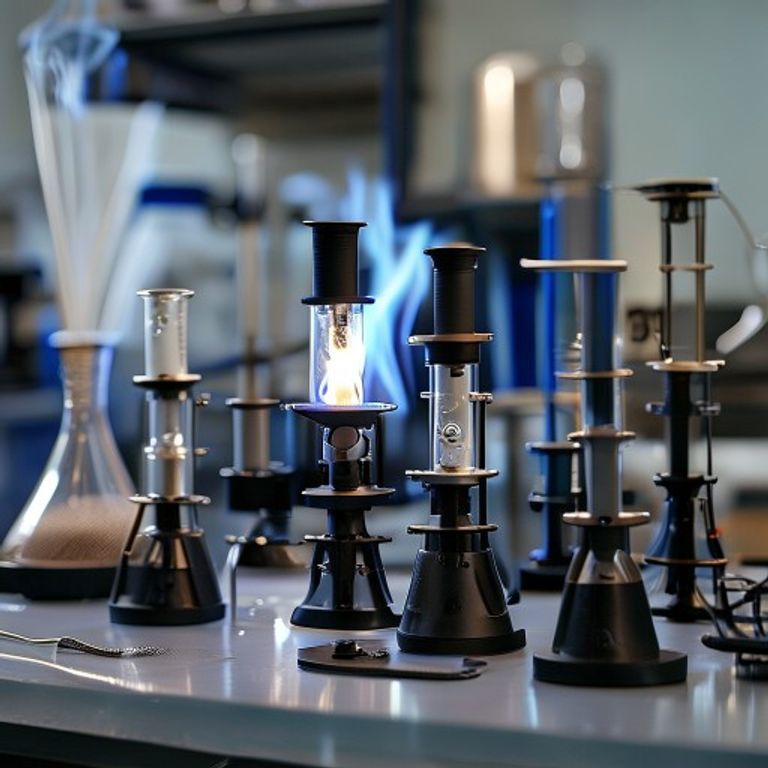
Unlocking the Heat: A Practical Guide to Different Bunsen Burner Types

In the world of scientific experimentation, having the right tools can make all the difference. And when it comes to laboratory heating equipment, few pieces are as iconic and essential as the Bunsen burner. But did you know that not all Bunsen burners are created equal? Just like different types of screwdrivers for different screws, there are specific bunsen burner models and their uses tailored for various lab tasks. Today, we’re going to dive deep into the fascinating world of these indispensable devices, exploring the different types of Bunsen burners explained, so you can confidently choose the right one for your needs.
For many of us, the image of a Bunsen burner immediately brings to mind chemistry classes or exciting experiments. It’s a simple yet incredibly effective device for producing a single, open gas flame, used for heating, sterilization, and combustion in countless laboratory settings. But beyond the standard model, there are variations designed for enhanced performance and control. Understanding these main bunsen burner variations is key to achieving optimal results and ensuring safety in your experiments.
The Classic: Standard Bunsen Burner
Let’s start with the one most of us are familiar with – the standard Bunsen burner. Invented by Robert Bunsen in 1855, this burner is a marvel of simplicity and efficiency. It typically consists of a flat, heavy base, a vertical tube, and a gas inlet connected to a gas supply. At the bottom of the tube, there’s a small collar or air hole adjustment mechanism. By rotating this collar, we can control the amount of air mixing with the gas before it ignites at the top of the tube. This simple flame control mechanism allows us to produce anything from a cool, luminous yellow flame (when the air hole is closed, indicating incomplete combustion) to a hot, roaring blue flame (when the air hole is fully open, signifying complete combustion).
Think of it like adjusting the air intake on a car engine; more air means more efficient burning. The standard Bunsen burner is perfect for general heating tasks, gentle boiling, and even flaming inoculating loops for sterilization. It’s our go-to for everyday lab work.
Stepping Up the Heat: The Meker Burner
Sometimes, we need a flame that’s hotter and more concentrated than what a standard Bunsen burner can provide. That’s where the Meker burner features come into play. Invented by Georges Meker, this burner looks a bit beefier than its standard counterpart. The most noticeable difference is its wider, perforated burner head, often topped with a wire gauze or grid. This design allows for a larger volume of air to mix with the gas, and the grid helps create a more uniform flame across a wider area, preventing flashback and producing a very hot, stable, and almost colorless flame.
Imagine heating a pan on a regular stove burner versus an industrial wok burner – the Meker burner is like that powerful wok burner, providing intense, even heat. We typically use Meker burners for tasks requiring higher temperatures, such as igniting crucibles, performing fusions, or quickly bringing solutions to a boil. It’s a workhorse for high-temperature applications.
Precision and Control: The Teclu Burner
For experiments demanding fine-tuned flame control, we often turn to the Teclu burner. Developed by Nicolae Teclu, this specific bunsen burner model and its uses are centered around adjustability. Its distinguishing feature is a conical screw-valve at the base of the main tube, rather than a rotating collar for air adjustment. This conical design allows for very precise control over the air-to-gas mixture, giving us an exceptionally stable and controllable flame, from a gentle warmth to an intense heat. The gas flow is also often adjustable independently.
Consider it like having a dimmer switch for your lab flame – you can get exactly the intensity you need. The Teclu burner is ideal for analytical chemistry applications, glassblowing, or any situation where a very stable and easily adjustable flame is critical. Its precision makes it a favorite among experienced chemists.
Alternatives and Safety: Beyond Gas Burners
While gas burners are prevalent, sometimes they aren’t suitable or available. This brings us to spirit lamp alternatives. A spirit lamp typically uses denatured alcohol as fuel and produces a much cooler flame compared to its gas-powered cousins. It’s often used in situations where a very gentle heat is needed or where gas lines are unavailable. However, its lower heat output and the open flame of liquid fuel mean it’s not a direct replacement for high-temperature tasks.
Regardless of the type we use, safety is paramount. Always ensure proper ventilation, check gas connections, and never leave an open flame unattended. When heating glassware, especially beakers or flasks, remember that using wire gauze for safe and even heating is crucial to prevent thermal shock and ensure uniform heat distribution. This little “unsung hero” prevents glassware from cracking due to direct flame contact.
How to Choose the Right Bunsen Burner Type
So, with all these options, how do you choose the right bunsen burner type? It boils down to your specific experimental needs:
- For general heating, sterilization, and everyday tasks: The standard Bunsen burner is your reliable friend.
- For high-temperature applications and intense, even heat: Opt for a Meker burner.
- For precision control and sensitive experiments: The Teclu burner offers the best adjustability.
- For very gentle heating or when gas isn’t available: A spirit lamp might be a suitable, albeit less powerful, alternative.
A comparison of various laboratory gas burners shows that while their basic function is the same, their design differences significantly impact their performance and suitability for different tasks. Understanding these nuances will help you perform your experiments more effectively and safely.
Frequently Asked Questions (FAQ)
Q: Can I use natural gas with any Bunsen burner?
A: Most Bunsen burners are designed for natural gas or LPG (liquefied petroleum gas). However, it’s essential to check the manufacturer’s specifications. Some burners might have different orifices for different gas types. Always ensure compatibility for safety and optimal performance.
Q: What does a yellow flame indicate on a Bunsen burner?
A: A yellow or luminous flame indicates incomplete combustion due to insufficient air mixing with the gas. This flame is cooler, less efficient, and can deposit soot. To get a hotter, blue flame, you need to open the air hole adjustment to allow more air in.
Q: Are spirit lamps safe to use for long periods?
A: Spirit lamps are generally safe for short-term, gentle heating. However, they use liquid fuel, which poses a different set of risks (spills, lower flash point). Always ensure the lamp is on a stable surface, never overfill it, and extinguish it properly after use. They produce less heat than gas burners, so they might not be efficient for prolonged heating needs.
Q: How do I know if my Bunsen burner is working correctly?
A: A correctly working Bunsen burner will produce a stable, quiet blue flame (when the air hole is open) with a distinct inner and outer cone. There should be no flickering, roaring, or unpleasant odor. If you notice any of these, check your gas connection, air hole adjustment, and ensure the burner is clean.
There you have it! From the familiar standard Bunsen to the powerful Meker and the precise Teclu, each Bunsen burner type has its own strengths and ideal applications. By understanding their characteristics, we can make informed decisions, ensuring our laboratory work is not only efficient but also safe and successful. So, the next time you reach for a burner, you’ll know exactly which tool is best suited for the job at hand!