Unraveling the Bunsen Burner Meaning: Your Essential Guide to This Lab Staple

Have you ever stepped into a chemistry lab and noticed that simple yet powerful heating apparatus? Chances are, you’ve seen a Bunsen burner in action. For many of us, it’s one of the first pieces of laboratory equipment we learn to use. But beyond just being a source of flame, what exactly is the bunsen burner meaning, and why has it remained an indispensable tool for over a century? Let’s dive in and explore this remarkable device together.
What Exactly Is a Bunsen Burner? (Definition and Parts)
At its core, a Bunsen burner is a type of gas burner commonly used in scientific laboratories. Its primary function is to safely produce a single, open flame, which we can control in terms of heat intensity and size. It’s a deceptively simple device, but its brilliance lies in its design. Imagine it as a miniature, controlled bonfire for your experiments.
To really understand it, let’s break down its key parts:
- Base: This sturdy, heavy part keeps the burner stable on your workbench, preventing it from tipping over.
- Gas Inlet: A small tube or nozzle where we connect the rubber tubing that supplies gas (usually natural gas or LPG) to the burner.
- Barrel (or Chimney): The long, vertical metal tube where the gas mixes with air. This is where the magic happens before the flame ignites.
- Collar (or Air Vent Regulator): This adjustable ring around the base of the barrel has openings (air holes). By rotating the collar, we can control how much air mixes with the gas. More air generally means a hotter, cleaner flame.
- Gas Valve/Needle Valve (often external to the burner itself, but crucial): Though often part of the lab bench’s gas tap, some burners have a small screw or valve at the base to fine-tune the gas flow.
Understanding these parts helps us appreciate how such a basic setup can achieve precise temperature control, making it a cornerstone of the chemistry lab.
A Glimpse into History: Who Invented the Bunsen Burner?
The history of the Bunsen burner is quite fascinating. While often attributed solely to Robert Bunsen, a German chemist, he didn’t actually “invent” it from scratch. Instead, in 1855, he improved upon existing designs of laboratory gas burners. His modifications made the burner much safer and more efficient by allowing for better mixing of gas and air before combustion, producing a hotter and less luminous flame. So, while others had similar ideas, Bunsen’s design became the standard, and that’s why we know it by his name today.
How Does This Marvel Work? (The Science Behind the Flame)
The principle behind how does a Bunsen burner work is actually quite elegant. Here’s a simplified breakdown:
- Gas Inflow: Gas enters through the gas inlet.
- Air Inflow: As the gas rushes up the barrel, it creates a low-pressure area, drawing air in through the air holes at the base (this is called the Venturi effect).
- Mixing: The gas and air mix thoroughly inside the barrel. This pre-mixing is crucial for efficient combustion.
- Ignition: When we introduce a spark or a flame (from a lighter or match) at the top of the barrel, the gas-air mixture ignites, producing a stable flame.
By adjusting the air holes and the gas flow, we can achieve different types of flames:
- Luminous Flame: If the air holes are closed or nearly closed, there’s not enough oxygen for complete combustion. This results in a yellow, sooty, and cooler flame. It’s often called a “safety flame” when lit but not in active use.
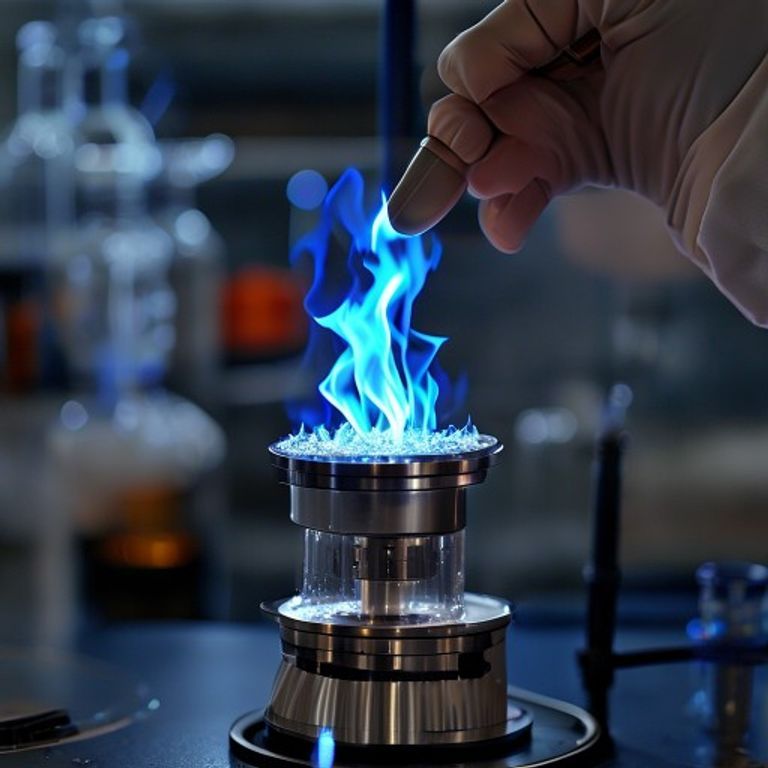
- Non-Luminous Flame: With enough air, we get a blue, hotter flame. This is the working flame for most experiments. It has distinct zones: an inner blue cone (cooler, unburnt gas) and an outer blue cone (hottest part).
- Roaring Flame: Too much air can lead to a noisy, unstable flame that might even “lift off” the barrel or blow itself out.
More Than Just a Flame: What Is a Bunsen Burner Used For? (Purpose in a Lab)
The purpose of a Bunsen burner in a lab goes far beyond simply “making fire.” It’s a versatile tool with several critical applications:
- General Heating: This is its most common use. We often use it to heat liquids in various containers, such as test tubes or, most commonly, to understand the true function of a beaker in every lab. It’s perfect for boiling water, dissolving solids, or speeding up chemical reactions.
- Sterilization: In microbiology, the Bunsen burner’s flame is essential for sterilizing inoculating loops, test tube mouths, and other instruments to prevent contamination.
- Combustion Experiments: It’s an excellent tool for demonstrating principles of combustion, observing flame tests, or burning small samples.
- Glass Bending and Shaping: With a steady flame, skilled technicians can heat and bend glass tubing for custom laboratory setups.
So, when someone asks, “what is a Bunsen burner used for?”, we can confidently say it’s a multi-talented workhorse!
Safety First! Using Your Bunsen Burner Responsibly
While invaluable, Bunsen burners must be handled with care. Here are some quick tips:
- Always wear safety goggles.
- Tie back long hair and secure loose clothing.
- Check gas tubing for cracks or damage before use.
- Never leave a lit burner unattended.
- Know the location of the nearest fire extinguisher.
- When not actively heating, adjust to a luminous “safety flame.”
Conclusion
From its clever design allowing precise flame control to its wide array of uses, the Bunsen burner truly embodies the spirit of practical science. It’s not just a simple heating apparatus; it’s a gateway to countless discoveries and experiments, helping us unlock the mysteries of the world around us. So the next time you see one, I hope you’ll have a deeper appreciation for this humble yet mighty piece of laboratory equipment.
FAQ
Q: What is the hottest part of a Bunsen burner flame?
A: The hottest part of a properly adjusted non-luminous (blue) flame is just above the tip of the inner blue cone. This is where the combustion is most complete.
Q: Can a Bunsen burner use any type of gas?
A: Most Bunsen burners are designed to use natural gas, propane, or butane. It’s important to ensure the burner and gas supply are compatible for safe and efficient operation.
Q: Why is the flame sometimes yellow and sooty?
A: A yellow, sooty flame (luminous flame) indicates incomplete combustion due to insufficient air mixing with the gas. You need to open the air holes on the collar to allow more oxygen in for a cleaner, hotter blue flame.
Q: Is a Bunsen burner dangerous?
A: Like any piece of equipment that produces an open flame, a Bunsen burner can be dangerous if not handled properly. However, with correct training and adherence to safety protocols, it’s a very safe and controllable tool.