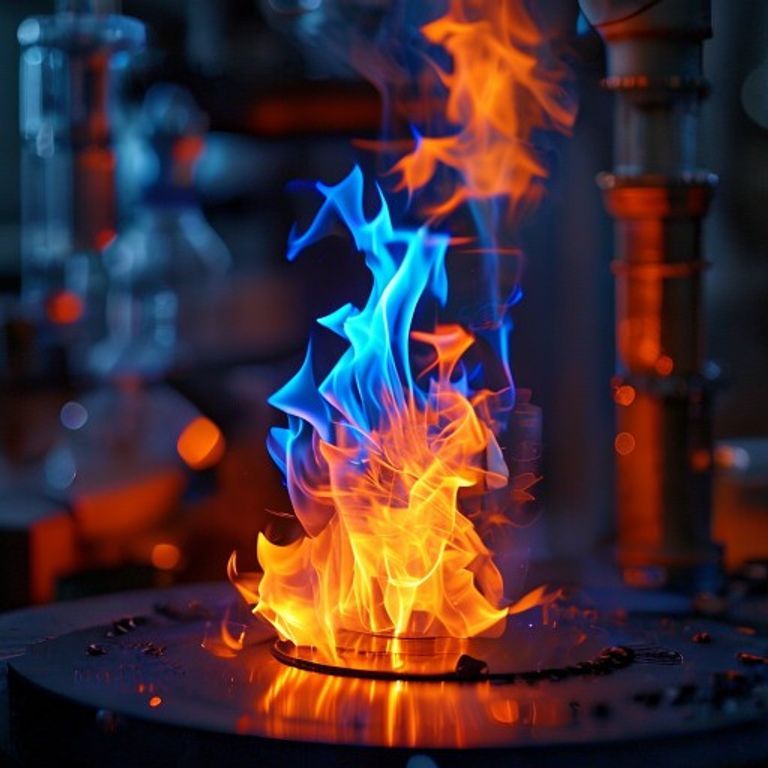
Unlocking the Power of Flames: A Deep Dive into Burner Chemistry

Unlocking the Power of Flames: A Deep Dive into Burner Chemistry
Have you ever paused to think about the incredible magic that unfolds every time we light a gas stove, start a car engine, or see smoke plumes from an industrial chimney? Behind every flame, there’s a complex world known as combustion, and at its very core lies what we call burner chemistry. It’s not just about fire burning something; it’s an extraordinary dance of molecules, transforming fuel into energy, heat, and sometimes, environmental challenges.
As someone fascinated by how the world around us works, I find that understanding the chemistry behind burners is key to countless innovations. From boosting energy efficiency in our homes to designing cleaner jet engines, it all boils down to a deep understanding of the chemical reactions that take place within a flame. Let’s explore further!
The Heart of the Flame: Basic Chemical Reactions
Simply put, combustion is an exothermic chemical reaction between a fuel and an oxidant, typically oxygen from the air, which produces heat and light. We often visualize it as “fuel + oxygen → products + energy.” Take methane (CH4), the primary component of natural gas, as an example. When it burns completely, the reaction is:
CH4 + 2O2 → CO2 + 2H2O + Energy
Looks straightforward, doesn’t it? Methane reacts with oxygen to produce carbon dioxide, water, and, of course, the thermal energy we harness. However, this is merely the tip of the iceberg. In industrial burners, fuels can be far more complex, such as heavy oils or coal, and the reactions involved are significantly more intricate.
Beyond the Basics: Unraveling Flame Chemistry
In reality, a flame isn’t a place where fuel instantly transforms into CO2 and H2O. It’s a cascade of thousands of sequential reactions involving highly reactive intermediate molecules, which we call radical species. Imagine thousands of tiny dancers (molecules) moving incredibly fast, colliding, and combining in a matter of nanoseconds. This is what occurs at the molecular level within a flame.
This process involves the breakdown of initial fuel molecules into smaller fragments like H, O, OH, and CH3. These radical species are what sustain the chain reactions, continuously breaking down and forming new molecules. Flame kinetics studies the rates and pathways of these reactions, providing us insights into how fire “works” from within. Understanding radical species formation in hydrocarbon flames is absolutely crucial for effectively controlling combustion.
The Quest for Efficiency: Optimizing Combustion Efficiency and Emissions
One of the primary goals in burner chemistry is to achieve efficient combustion. This means extracting the maximum energy from the fuel while minimizing waste. Why is this important? Because inefficient combustion means we’re wasting money and resources, and often generating more pollutants.
How do we achieve this? Several key factors come into play:
- Fuel-Air Ratio: Maintaining the right balance between the amount of fuel and oxygen is fundamental. Too much air (lean combustion) can cool the flame, while too little (rich combustion) results in incompletely burned products like carbon monoxide (CO) and soot.
- Mixing: Fuel and air must be thoroughly mixed before ignition. Imagine trying to burn a poorly stacked pile of wood; some parts will burn, others won’t. Modern burners are designed to ensure optimal mixing.
- Temperature and Residence Time: Sufficiently high temperatures are required to initiate and sustain reactions, and the fuel must have enough time in the hot zone to burn completely.
In laboratory-scale studies, especially when developing new fuels or burner designs, we often need to make extremely precise measurements to ensure the correct fuel-air ratio or to analyze liquid samples. For preparing liquid fuel or oxidant samples, for example, understanding the measuring cylinder function becomes crucial for accurate volume measurement. Similarly, for handling smaller volumes with even higher precision, mastering pipet function is essential for accurate liquid transfer in the lab.
The Dark Side: Understanding Flame Chemistry and Pollutant Formation
Unfortunately, perfect combustion is rare in the real world. Unwanted byproducts, which we call pollutants, are often formed. Two major pollutants of serious concern are Nitrogen Oxides (NOx) and carbon monoxide (CO).
- NOx: Formed when nitrogen from the air reacts with oxygen at high temperatures within the flame. This is a significant issue because NOx contributes to acid rain and smog.
- CO: Results from incomplete combustion, where there isn’t enough oxygen to convert all carbon into CO2. CO is a toxic gas.
- Soot: Fine carbon particles formed from unburned or partially burned hydrocarbon fuels, often seen as black smoke.
Understanding flame chemistry and pollutant formation is the first step toward developing mitigation strategies, such as designing low-NOx burners or using alternative fuels. This is an area where the science of combustion science is continuously evolving.
Seeing the Unseen: Advanced Diagnostic Techniques for Burner Performance
How can we possibly know what’s truly happening inside a flame that’s so hot and fast? We can’t simply observe it with the naked eye. This is where advanced diagnostic techniques for burner performance come into play. Scientists use sophisticated tools like laser spectroscopy, gas chromatography, and infrared imaging to “see” temperatures, chemical species concentrations, and flow patterns within the flame.
These techniques allow us to map temperature distributions, identify locations of radical formation, and even perform exhaust gas analysis in real-time. With this data, we can refine burner designs, optimize operating conditions, and significantly reduce pollutant emissions. It’s like having a super advanced camera that can see the molecules dancing inside the fire!
Conclusion
Burner chemistry is a dynamic and essential field, far more than just “burning something.” It’s a complex science involving fuel oxidation, heat transfer, and the intricate interactions of thousands of molecules. By continuing to delve into the chemical reactions in industrial burners, we can pave the way for cleaner, more efficient, and more sustainable energy systems in the future. From our own kitchens to giant power plants, our understanding of flame chemistry continues to shape our world.
FAQ (Frequently Asked Questions)
Q: What is the difference between complete and incomplete combustion?
A: Complete combustion occurs when there’s enough oxygen to convert all fuel into carbon dioxide (CO2) and water (H2O), yielding maximum energy and minimal pollutants (ideally). Incomplete combustion happens when oxygen is insufficient, resulting in byproducts like carbon monoxide (CO), soot, and unburned fuel, which is less efficient and more polluting.
Q: Why is flame temperature important?
A: Flame temperature is crucial because it affects the rate of chemical reactions and the formation of pollutants. Higher temperatures generally accelerate reactions and increase combustion efficiency, but can also increase NOx formation. Controlling temperature is key to balancing efficiency and emissions.
Q: How can we reduce pollutant emissions from burners?
A: There are many ways, including: optimizing fuel-air ratio and mixing, employing low-NOx combustion technologies (like staged combustion or flue gas recirculation), utilizing catalysts, or switching to cleaner fuels. Burner design also plays a crucial role.
Q: Is burner chemistry only relevant for large industries?
A: Absolutely not! While its impact is greatest in industry, the principles of burner chemistry apply to every combustion application, from household gas stoves, candles, to our vehicle engines. Understanding its basics helps us use energy more wisely everywhere.