


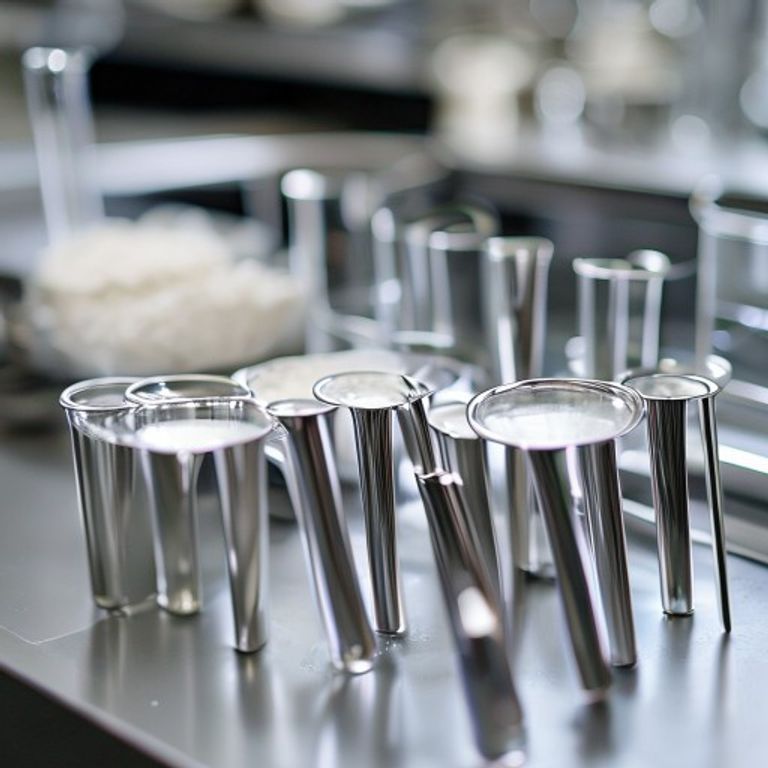
The Unsung Hero: Why Every Chemistry Spatula Deserves Your Precision and Respect

In the vast world of chemistry, where complex reactions and sophisticated instruments often steal the spotlight, there’s one humble tool that quietly yet fundamentally supports almost every experiment we undertake: the chemistry spatula. It might seem like a simple piece of lab equipment, almost too basic to warrant much thought. But trust me, as someone who spends a lot of time in the lab, I can tell you that understanding and mastering the use of this versatile instrument is absolutely crucial for accuracy, efficiency, and safety.
Just like a chef needs the right knife, a chemist needs the right spatula. From scooping tiny amounts of precious reagents to carefully transferring delicate powders, the chemistry spatula is an extension of our hands, allowing us to interact with chemicals in a controlled and precise manner. Let’s dive deeper into why this seemingly simple tool is, in fact, an indispensable part of any chemist’s toolkit.
What Exactly is a Chemistry Spatula?
At its core, a chemistry spatula is a small, hand-held tool designed for handling and transferring solid chemicals, particularly powders and granular substances. Think of it as a miniature shovel or spoon for the lab. While they all serve a similar purpose, you’ll find them in a variety of materials and designs, each suited for specific tasks.
- Materials: The most common type you’ll encounter is the stainless steel chemistry spatula. Stainless steel is preferred because it’s durable, resistant to corrosion from many chemicals, and easy to clean. You might also find plastic spatulas for non-critical applications or where metal contamination is a concern, and sometimes even ceramic ones for very specific high-temperature uses.
- Design: Spatulas usually have a flat blade at one end and sometimes a spoon-like scoop or a different blade shape at the other. This dual-ended design makes them incredibly versatile.
The Many Shapes and Sizes: From Micro to Macro Tasks
One of the beauties of the chemistry spatula is its adaptability. We don’t just have one type; we have an arsenal of them, each designed for optimal performance in different scenarios. Imagine trying to scoop a tiny speck of powder with a large serving spoon – it just wouldn’t work! The same principle applies in the lab.
Small Laboratory Spatulas and Micro Spatulas
When we’re dealing with precious or potent chemicals, or when we need to transfer incredibly small quantities, a small laboratory spatula or even a specialized micro spatula for chemical powders comes into play. These are often extremely thin and narrow, sometimes with a pointed tip, allowing for precise manipulation of milligrams or even micrograms of material. They are perfect for applications like transferring a tiny amount of reagent onto a spot plate in chemistry for qualitative analysis, where precision is paramount.
Scoops and Spoon Spatulas
For slightly larger quantities, especially when we’re moving powdered reagents from a bottle to a beaker or a weighing boat, a spatula with a small spoon-like scoop on one end is incredibly useful. These are fantastic for quickly and cleanly gathering a manageable amount of solid without spilling.
Mastering the Art of Transfer and Measurement
Knowing how to use a lab spatula correctly is more of an art than a science, but it’s an art that can be quickly learned and refined. Here are some practical tips I always share:
- Scooping with Care: When scooping powders from a container, always use the flat end or the spoon end, depending on the amount needed. Avoid digging vigorously, as this can create dust and potentially contaminate your sample or the surrounding environment. Gentle scraping along the bottom or side of the container is usually sufficient.
- Precision on the Balance: When spatula for measuring chemicals on an analytical balance, precision is everything. I usually start by taring my weighing boat or watch glass, then gently tap the spatula to slowly release the chemical onto the boat. Small, controlled taps are key to getting the exact weight you need without overshooting. It’s a bit like adding salt to a dish – you can always add more, but you can’t easily take it away!
- Transferring without Loss: After weighing, carefully transfer the chemical to your reaction vessel (beaker, flask, or volumetric flask). Use the spatula to gently scrape all the powder off the weighing boat. A technique I often use is to gently tap the side of the spatula against the edge of the vessel to dislodge any clinging particles.
- Mixing and Stirring: While not its primary role, a spatula can also be used for gently mixing small amounts of solids or stirring viscous solutions in small containers.
Care and Maintenance: Keeping Your Spatula Pristine
A clean spatula is a happy spatula, and more importantly, a reliable one. Contamination is a chemist’s worst nightmare, and a dirty spatula is a direct route to ruined experiments. Always:
- Clean your spatula thoroughly with the appropriate solvent (often distilled water, sometimes ethanol or acetone) after each use.
- Wipe it dry immediately to prevent rust, especially for stainless steel spatulas.
- Store it in a clean, dry place, preferably in a beaker or a designated drawer to avoid bending or contamination.
Conclusion
So, there you have it. The chemistry spatula, often overlooked, is a cornerstone of good laboratory practice. It enables precision, prevents contamination, and ensures the smooth execution of countless experiments. Next time you pick up this humble tool, remember its critical role and use it with the respect and care it deserves. After all, even the smallest tools can make the biggest difference in the world of science!
FAQ About Chemistry Spatulas
Q1: Can I use a regular kitchen spatula in the lab?
A1: Absolutely not! Kitchen spatulas are generally not made from materials that are chemical-resistant, and they are definitely not designed for the precision needed in laboratory work. Plus, they might introduce contaminants. Always use lab-grade equipment.
Q2: How do I choose the right spatula for a task?
A2: Consider the amount of chemical you need to handle (small amounts need micro spatulas, larger amounts might use a scoop spatula), the nature of the chemical (corrosive chemicals might need specific materials), and the vessel you are transferring to.
Q3: What’s the best way to clean a stainless steel chemistry spatula?
A3: For most general lab uses, washing with soap and distilled water, followed by a rinse and thorough drying, is sufficient. For stubborn residues or specific chemical contamination, consult your lab’s safety protocols, which might involve solvents like ethanol or acetone, followed by water rinses.
Q4: Are there any alternatives to a spatula for transferring powders?
A4: Sometimes, for very coarse powders, we might use a clean spoon. For extremely small and delicate transfers, some labs use specialized micro-tools or even custom-bent wires. However, the spatula remains the most versatile and common tool for general powder handling.







