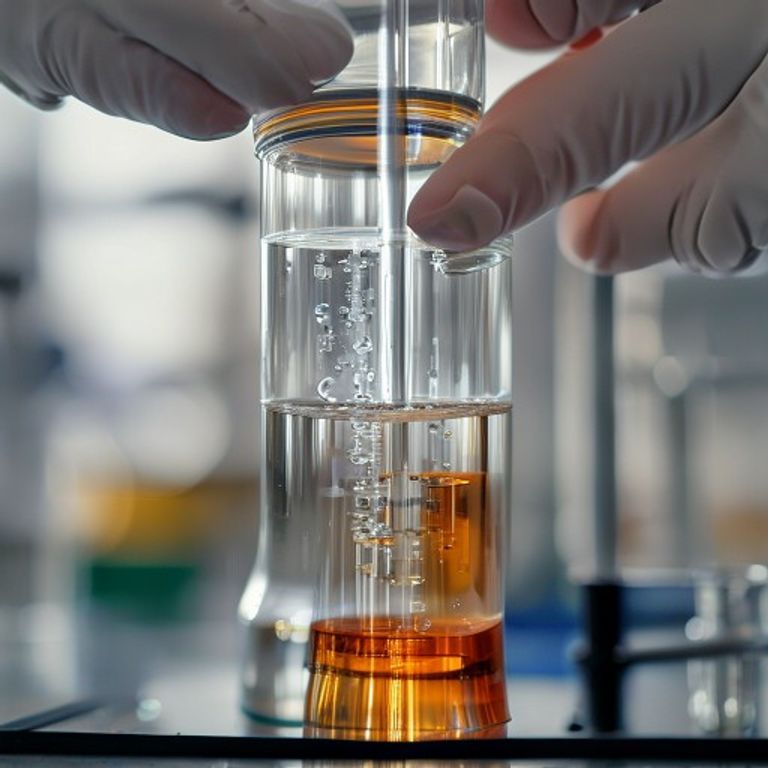
Dévoilement de la magie : utilisation pratique de l'entonnoir de séparation dans vos expériences de laboratoire

Dévoilement de la magie : utilisation pratique de l'entonnoir de séparation dans vos expériences de laboratoire
Have you ever looked at a mixture of oil and water and wondered how you could separate them perfectly? It seems like a simple task, but in the world of chemistry, separating different liquid components is a fundamental process. That’s where our unsung hero, the separating funnel, steps in. It’s a piece of glassware that might look unassuming, but its role in laboratories, especially in organic chemistry and synthesis, is absolutely crucial. We’re talking about precision, efficiency, and making sure our chemical reactions yield pure products. So, let’s dive deep and explore the fascinating world of separating funnel uses!
Qu'est-ce qu'un entonnoir séparé exactement?
Before we explore its uses, let’s quickly get acquainted with this clever tool. Imagine a cone-shaped glass container with a stopper at the top and a stopcock (a fancy word for a valve) at the bottom. That’s essentially a separating funnel! It’s designed specifically to separate liquides immiscibles – liquids that don’t mix and form distinct layers, much like oil and water in a salad dressing. Its unique shape allows for the clear visualization of these layers and the precise draining of the bottom layer, leaving the top layer behind. Simple, yet brilliant!
The Core Function: Separating Immiscible Liquids
The primary use of a separating funnel, as you might guess, is to separate two or more immiscible liquids. Think of it like this: when you mix two liquids that don’t dissolve in each other, they will settle into layers based on their densities. The denser liquid will sink to the bottom, and the less dense liquid will float on top. Our separating funnel makes it incredibly easy to isolate these layers.
Let’s take a common example: separating an organic solvent (like diethyl ether) from water. In many chemical reactions, we need to extract a desired product from an aqueous solution into an organic solvent. The separating funnel allows us to perform this extraction liquide-liquide with ease. We simply add our mixture, shake it gently (while remembering to vent the pressure!), let the layers settle, and then carefully drain one layer at a time.
How to Use a Separating Funnel for Extraction: A Step-by-Step Guide
Using a separating funnel effectively is a skill every aspiring chemist learns. Here’s a quick rundown of how we typically do it in the lab:
- Configuration & #160;: We always make sure the stopcock is closed and the funnel is securely held in a retort stand with a clamp. Safety first, right?
- Adding Liquids: Carefully pour the mixture of immiscible liquids into the funnel through the top opening. Sometimes, we might need to add specific solvents to facilitate the separation or extraction. It’s good practice to know the approximate volumes beforehand, and for precise measurements, we often rely on utilisation essentielle du cylindre gradué to ensure accuracy in our experiments.
- Mixing (Shaking & Venting): Seal the top with the stopper and gently invert and shake the funnel to mix the contents. This allows the solute to distribute between the two liquid phases. Crucially, we *must* vent the pressure frequently by opening the stopcock while the funnel is inverted, pointing away from ourselves and others. This prevents pressure buildup from volatile solvents.
- Settling the Layers: Place the funnel back in the clamp and remove the stopper. Allow the layers to separate completely. This might take a few minutes, depending on the liquids. You’ll clearly see distinct boundaries between the aqueous layer et les organic layer.
- Draining: Once the layers are distinct, slowly open the stopcock and drain the bottom layer into a clean beaker. As the interface approaches the stopcock, we close it carefully, ensuring that only the bottom layer has been collected. The top layer can then be poured out from the top opening into another container.
Applications of Separating Funnels in Chemistry
The applications are vast and varied. Let’s look at some key examples:
- Organic Synthesis: This is probably where separating funnels shine brightest. After a chemical reaction, we often have a mixture of desired products, unreacted starting materials, and byproducts. We use liquid-liquid extraction to selectively move our product into a specific solvent, separating it from impurities.
- Purification Processes: Beyond initial synthesis, separating funnels are used for washing organic layers with water or brine (salt solution) to remove water-soluble impurities like acids, bases, or salts.
- Environmental Analysis: In environmental labs, separating funnels can be used to extract pollutants from water samples into organic solvents for analysis.
- Produits pharmaceutiques: In drug development and production, separating funnels play a role in isolating active pharmaceutical ingredients from reaction mixtures.
Practical Tips for Working with Separating Funnels
From my experience, a few pointers can make a big difference:
- Always ensure the stopcock is greased (if it’s glass) and the stopper fits snugly to prevent leaks.
- Vent frequently, especially when using volatile solvents. Don’t forget this step!
- Allow sufficient time for layers to settle completely. Patience is a virtue here.
- Label your beakers or flasks clearly as you drain layers, so you don’t mix them up.
- Sometimes, emulsions (stable mixtures of two immiscible liquids) can form. Gently swirling or adding a small amount of brine can sometimes help break them.
Conclusion
The separating funnel, though simple in design, is an indispensable tool in any chemistry laboratory. From routine extractions in organic synthesis to crucial purification steps, its ability to cleanly separate immiscible liquids underpins countless experiments and discoveries. Next time you see one, you’ll know it’s not just a fancy piece of glass, but a gateway to purer compounds and successful scientific endeavors. It truly makes the magic of separation happen right before our eyes!
Foire aux questions (FAQ)
Q: Que sont les liquides immiscibles?
A: Immiscible liquids are two or more liquids that do not mix to form a homogeneous solution. Instead, they form distinct layers, like oil and water.
Q: Why do I need to vent the separating funnel during extraction?
A: Venting is crucial because volatile solvents can build up pressure inside the sealed funnel during shaking. This pressure can cause the stopper to pop off or even shatter the glassware, which is definitely something we want to avoid for safety reasons.
Q: How do I know which layer is which in the separating funnel?
A: Generally, the denser liquid will be the bottom layer, and the less dense liquid will be the top layer. For common solvents, you can look up their densities. A simple trick is to add a drop of water; if it dissolves in the bottom layer, that’s your aqueous layer.
Q: What should I do if an emulsion forms in my separating funnel?
A: Emulsions can be tricky! You can try gently swirling the funnel, adding a small amount of saturated brine solution (saltwater), cooling or heating the mixture slightly, or simply waiting longer for the emulsion to break naturally. Sometimes, centrifuging a small portion can help, but a separating funnel itself isn’t designed for that.