Erlenmeyer Flask vs. Volumetric Flask: Your Essential Guide to Lab Accuracy

Introduction: The Tale of Two Flasks
Ever found yourself in the lab, staring at a collection of glassware and wondering, “Which flask should I use for this?” It’s a common dilemma, especially when it comes to two fundamental pieces of equipment: the Erlenmeyer flask and the volumetric flask. At first glance, they both hold liquids, but trust me, their differences are as significant as night and day when it comes to precision and purpose.
Here at Mr. Erwin Widianto, we’re all about making complex lab concepts easy to understand. Today, we’re diving deep into the world of the Erlenmeyer flask vs volumetric flask. We’ll explore what is the difference between Erlenmeyer and volumetric flasks, when to use an Erlenmeyer flask versus a volumetric flask, and crucially, an accuracy comparison of Erlenmeyer vs volumetric flask. By the end, you’ll know exactly which flask to reach for, ensuring your experiments are both efficient and accurate.
Meet the Erlenmeyer Flask: Your Lab Workhorse
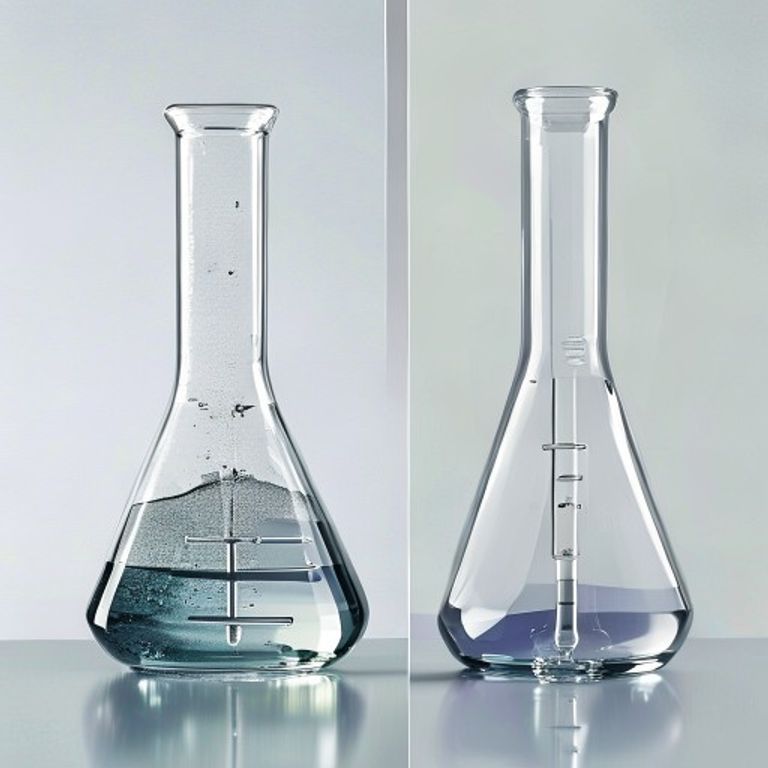
Let’s start with the Erlenmeyer flask, often affectionately called a conical flask. Imagine a cone-shaped body with a flat bottom and a cylindrical neck. It’s probably one of the most recognizable pieces of laboratory glassware types out there. Why is it so popular? Its design is incredibly versatile.
- Mixing and Swirling: The conical shape makes it perfect for swirling liquids without spilling, especially during processes like titration process.
- Heating Solutions: Its wide base allows for even heating, and the narrow neck helps reduce solvent loss through evaporation.
- Temporary Storage: It’s great for holding solutions temporarily.
- Not for Precision: Crucially, Erlenmeyer flasks usually have approximate volume markings. Think of them like the general measuring cups you might use at home for cooking – good enough for many tasks, but not for baking where exact measurements are critical. This means you can’t measure volume precisely with an Erlenmeyer flask.
We often use Erlenmeyer flasks when the exact volume isn’t the primary concern, but rather mixing, reacting, or heating a solution.
Introducing the Volumetric Flask: The Precision Partner
Now, let’s turn our attention to the volumetric flask. This flask is the epitome of precision in volume measurement. It typically has a pear-shaped body, a long, narrow neck, and a single, etched calibration mark around the neck. This mark signifies one specific, highly accurate volume at a given temperature (usually 20°C).
The design of a volumetric flask screams accuracy:
- Highly Calibrated: It’s manufactured to contain a very precise volume of liquid when filled exactly to its calibration mark.
- Solution Preparation: The primary uses of volumetric flasks are for preparing standard solutions with extreme accuracy, such as when you need a solution with a known molarity for volumetric analysis.
- Dilution: They are also indispensable for diluting stock solutions to an exact final volume.
If you’re making a solution for a critical experiment where concentration absolutely has to be spot-on, a volumetric flask is your best friend. It’s like the professional measuring tool a high-end pastry chef uses to ensure every ingredient is perfect.
Key Differences: Erlenmeyer vs. Volumetric Flask at a Glance
To summarize, here’s a quick comparison of the Erlenmeyer flask vs volumetric flask:
- Shape: Erlenmeyer is conical with a wide base; Volumetric is pear-shaped with a long, narrow neck.
- Calibration: Erlenmeyer has approximate, multiple volume markings; Volumetric has a single, highly precise calibration mark.
- Accuracy: Erlenmeyer is for approximate volumes; Volumetric is for exact, highly accurate volumes.
- Primary Use: Erlenmeyer is for mixing, heating, and general reactions; Volumetric is for precise solution preparation and dilution.
When to Use Which Flask: Practical Applications
Choosing the right flask isn’t about one being “better” than the other; it’s about using the right tool for the job. Think about the specific task at hand:
Choose an Erlenmeyer Flask When:
- You need to mix or swirl liquids vigorously without splashing.
- You’re performing a titration where the flask acts as a reaction vessel.
- You need to heat a solution.
- You’re collecting a filtrate or storing a solution temporarily, and exact volume isn’t critical.
Choose a Volumetric Flask When:
- You need to prepare a solution of a precise concentration (a standard solution).
- You are diluting a stock solution to a specific, accurate final volume.
- Accuracy in volume measurement is absolutely paramount for your experimental results.
For tasks requiring precision beyond what an Erlenmeyer can offer, but not necessarily the contained accuracy of a volumetric flask, other tools like a measuring cylinder for accurate liquid measurements come into play. And for even finer, smaller volume precision, you might find yourself mastering pipette uses in chemistry.
Conclusion: The Right Tool for the Right Task
Understanding the distinction between an Erlenmeyer flask and a volumetric flask is crucial for anyone working in a lab. It’s not just about knowing what they look like, but understanding their intended primary uses and, most importantly, their accuracy comparison. While the Erlenmeyer flask is your versatile, everyday workhorse for general lab tasks, the volumetric flask is your specialized instrument for achieving unparalleled precision in volume measurement.
By making the correct choice, you’re not just following lab protocols; you’re ensuring the reliability and validity of your experimental results. Happy experimenting!
FAQ: Your Questions Answered
Can you measure volume precisely with an Erlenmeyer flask?
No, you generally cannot measure volume precisely with an Erlenmeyer flask. While they have markings, these are approximate and designed for rough estimations or indicating maximum capacity, not for accurate volumetric measurements. For precision, you should use volumetric flasks, pipettes, or calibrated cylinders.
What is the main difference between an Erlenmeyer flask and a volumetric flask?
The main difference lies in their purpose and accuracy. Erlenmeyer flasks are designed for mixing, heating, and reactions, offering approximate volume indications. Volumetric flasks, on the other hand, are specifically designed for preparing solutions of exact, highly accurate volumes, featuring a single, precise calibration mark.
When should I use an Erlenmeyer flask?
Use an Erlenmeyer flask when you need to mix, swirl, or heat solutions, perform titrations, or store liquids temporarily where the exact volume is not a critical factor.
When should I use a volumetric flask?
Use a volumetric flask when you need to prepare a solution with a highly precise and known concentration, or when accurately diluting a solution to an exact final volume.
Why is a volumetric flask more accurate than an Erlenmeyer flask?
A volumetric flask is more accurate because it is precisely calibrated to contain a specific volume at a particular temperature, indicated by a single, narrow calibration mark. Its long, narrow neck minimizes meniscus reading errors. Erlenmeyer flasks have wider necks and less precise markings, making them unsuitable for accurate measurements.