


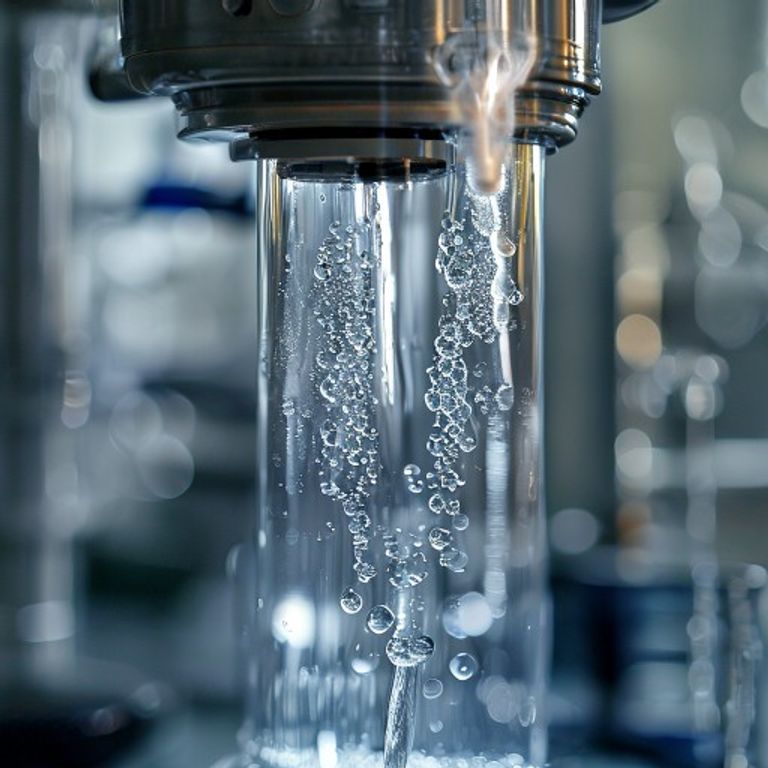
The Unsung Hero: Unveiling the Chemistry Condenser’s Vital Role in Your Lab

Introduction: The Quiet Workhorse of Chemical Reactions
Have you ever wondered how chemists manage to purify liquids or keep a reaction simmering without losing precious reagents to the air? Often, the unsung hero behind these crucial processes is a piece of humble glassware called the chemistry condenser. It might look like just a fancy tube, but its function is absolutely vital for countless experiments, from simple distillation to complex organic syntheses. Today, we’re going to dive deep into the world of condensers, exploring what they are, how they work, and why they’re indispensable in any chemistry lab. Think of it as the air conditioner for your bubbling beakers and flasks – quietly but effectively keeping everything in check!
What Exactly is a Chemistry Condenser?
At its core, a chemistry condenser is a laboratory apparatus designed to cool hot vapors, causing them to condense back into liquid form. Imagine boiling water in a pot and seeing steam rise. If you hold a cold plate over that steam, you’ll notice water droplets forming on the plate – that’s condensation! A condenser does this same job, but in a much more controlled and efficient manner within a chemical setup. It’s typically made of borosilicate glass, which can withstand drastic temperature changes, making it perfect for the demanding environment of chemical reactions.
How Does a Condenser Work Its Magic?
The principle behind how a condenser works in chemistry is beautifully simple: heat transfer. Most condensers have an inner tube through which the hot vapor flows and an outer jacket through which a cooling fluid (usually water) circulates. As the hot vapor travels through the inner tube, it comes into contact with the cool glass walls. The cooling water continuously removes heat from the glass, which in turn removes heat from the vapor. This loss of heat causes the vapor’s molecules to slow down and lose energy, transitioning them from a gaseous state back into a liquid state. This newly formed liquid then drips down, ready to be collected or returned to the reaction mixture.
Types of Condensers You’ll Encounter in the Lab
Just like there isn’t a “one-size-fits-all” wrench for every mechanical job, there isn’t a single condenser design for every chemical process. There are several types of condensers in a chemistry lab, each optimized for specific applications:
- Liebig Condenser: This is perhaps the most basic and common type. It features a straight inner tube surrounded by a straight outer jacket. It’s excellent for simple distillation where moderate cooling is sufficient.
- Graham Condenser: Characterized by a coiled inner tube within a straight jacket. The increased surface area provided by the coil makes it more efficient for cooling, but it can sometimes accumulate liquid due to its design.
- Allihn Condenser: Also known as a “bulb” or “finger” condenser, it has a series of bulbs or indentations in the inner tube, which increases the surface area for condensation. This design makes it particularly effective for reflux.
- Dimroth Condenser: Features a coiled cooling jacket inside the vapor path, offering very efficient cooling due to its large surface area and excellent contact with the vapor.
- Air Condenser: The simplest of them all, it’s just a long glass tube. It relies on the ambient air to cool the vapors. Only suitable for very high-boiling point liquids where minimal cooling is required, as its efficiency is low.
The Vital Role of Reflux Condensers in Organic Chemistry
One of the most frequent applications you’ll see is the reflux condenser organic chemistry setup. Reflux is a technique where a reaction mixture is heated to its boiling point for an extended period, but the vaporized solvent is continuously cooled and condensed back into the reaction vessel. This allows chemists to heat a reaction without losing solvent or reactants, essentially creating a closed system. The condenser, often an Allihn or Liebig, is positioned vertically above the reaction flask, ensuring that any vapor that escapes is immediately cooled and returned, maintaining the reaction volume and concentration.
The Power of Cooling Water: Water-Cooled Condenser Function Chemistry
The efficiency of most condensers hinges on the continuous flow of cooling water. The water-cooled condenser function chemistry relies on a steady stream of cold water entering at the bottom of the outer jacket and exiting at the top. This counter-current flow ensures that the coldest water meets the coolest vapor just before it exits the condenser, maximizing heat transfer efficiency. Without proper cooling water circulation, a condenser wouldn’t be able to perform its job effectively, leading to loss of solvent or incomplete condensation, which can jeopardize an experiment’s success.
Laboratory Condenser Uses and Maintenance
Beyond distillation and reflux, laboratory condenser uses and maintenance span various areas. They are critical in:
- Solvent Recovery: Capturing and reusing solvents after an experiment.
- Evaporation: Concentrating solutions by removing solvent and then collecting it.
- Extraction: Part of setups like Soxhlet extractors.
When it comes to maintenance, keeping your condensers clean is paramount. After each use, they should be rinsed thoroughly, typically with solvent, then water, and finally distilled water, followed by drying. Inspect them regularly for chips, cracks, or any blockages in the cooling jacket, as these can severely impair their function or even cause safety hazards. Proper care ensures their longevity and reliable performance.
Conclusion: An Indispensable Tool for Every Chemist
So, the next time you see a seemingly simple glass tube connected to a swirling flask of liquid, you’ll know it’s much more than just a piece of glassware. The chemistry condenser is a sophisticated and essential tool that enables precise control over chemical reactions and purification processes. From preventing solvent loss during reflux to ensuring efficient separation in distillation, its role is truly fundamental. Understanding how these ingenious devices work and how to properly use and maintain them is a key skill for any aspiring or experienced chemist. It truly is the quiet workhorse, ensuring our chemical adventures run smoothly and safely.
Frequently Asked Questions (FAQ)
Q1: Why does the cooling water go in at the bottom and out at the top of a condenser?
A: This setup ensures maximum cooling efficiency. By introducing cold water at the bottom, it fills the jacket completely, pushing warmer water out from the top. This counter-current flow means that the coolest water is always interacting with the hottest incoming vapor, providing the most effective heat exchange.
Q2: Can I use tap water for cooling in a condenser?
A: Yes, tap water is commonly used for cooling in most laboratory condensers. However, in areas with very hard water, mineral deposits can build up over time in the cooling jacket. In such cases, using distilled or deionized water, or periodically flushing the condenser with a mild acid solution, might be necessary to prevent blockages.
Q3: What’s the difference between a condenser and a distillation column?
A: While both are used in distillation, they serve different primary functions. A condenser’s sole purpose is to cool vapor back into liquid. A distillation column, on the other hand, is designed to separate liquid mixtures into their components based on differences in their boiling points before the vapor even reaches the condenser. It provides multiple vaporization-condensation cycles to achieve better separation, and a condenser is typically attached to the top of it to collect the purified vapor.







