


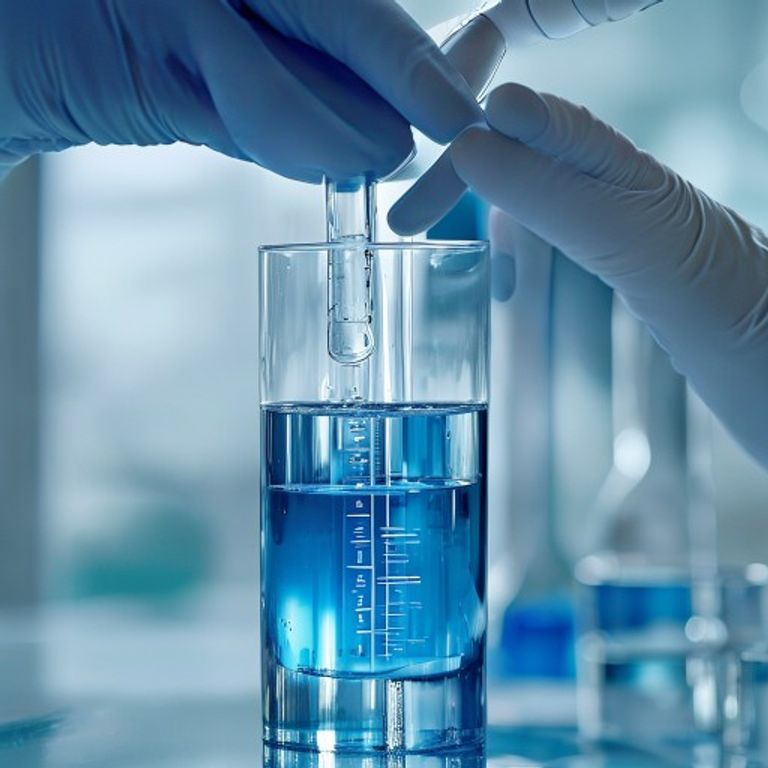
Unlocking Lab Success: Maîtriser l'exactitude volumétrique pour les résultats de précision

Ever felt like your experimental results were a bit… off? You followed all the steps, double-checked your calculations, but still, something wasn’t quite right. Often, the culprit isn’t a complex chemical reaction, but something much simpler: the precision of your basic verrerie de laboratoire, especially your volumetric flasks. As content writers, we know that attention to detail can make all the difference, and in the lab, this translates directly to the precision and accuracy of your measurements.
Today, we’re diving deep into the world of volumetric flask accuracy. It might sound like a minor detail, but trust me, understanding and optimizing the accuracy of these essential lab tools can be the secret ingredient to reproducible and reliable experimental outcomes. Think of it like baking a cake – if you measure your flour or sugar even slightly off, the whole recipe can fail. In the lab, the stakes are often much higher!
What Makes Volumetric Flasks So Special?
Unlike beakers or Erlenmeyer flasks, which are designed for mixing or holding solutions, volumetric flasks are specifically engineered for highly accurate volume measurements. They have a narrow neck with a single calibration mark (often called the meniscus mark), indicating a precise volume at a specific temperature (usually 20°C). This design minimizes the surface area at the point of measurement, reducing potential erreur de mesure and allowing for incredibly precise dilutions and solution preparations.
Class A vs. Class B: The Volumetric Flask Accuracy Spectrum
When you walk into a lab, you’ll often see volumetric flasks labeled either “Class A” or “Class B”. What’s the difference? It’s all about their tolerance – how much deviation from the stated volume is acceptable. Understanding volumetric flask accuracy Class A vs B is fundamental for any lab work.
Class A Volumetric Flasks
These are the champions of precision. Class A flasks are manufactured to extremely tight tolerances, meaning their actual volume is very, very close to the marked volume. For example, a 100 mL Class A flask might have a tolerance of ±0.08 mL. They are perfect for analytical chemistry, quantitative analysis, and anywhere high precision and accuracy are paramount, such as preparing primary standards or performing titrations. Think of them as the finely tuned sports cars of the lab.
Class B Volumetric Flasks
Class B flasks are still good, but they have a slightly wider tolerance. A 100 mL Class B flask might have a tolerance of ±0.16 mL. While still suitable for many general lab applications, they are less precise than Class A. They are often used for general-purpose preparations where extreme accuracy isn’t critical, like preparing reagents for qualitative tests or student experiments where the focus is on learning the technique rather than ultra-high precision. They are more like the reliable family sedans.
Choosing the right class is the first step in ensuring good volumetric flask accuracy for your specific experimental needs.
Factors Affecting Volumetric Flask Accuracy: What Can Go Wrong?
Even with a Class A flask, various factors can still compromise your volumetric flask accuracy. It’s not just about the flask itself; your technique and environment play a huge role. Here are some common factors affecting volumetric flask accuracy we should always be mindful of:
- Température: Volumetric flasks are calibrated at a specific temperature (usually 20°C). If your solution or the flask itself is significantly warmer or cooler, the volume of the liquid will expand or contract, leading to an inaccurate measurement. It’s like trying to measure something with a ruler that shrinks or expands with the weather!
- Parallax Error: This is a classic. When reading the meniscus (the curved surface of the liquid), if your eye isn’t level with the mark, you’ll read the volume incorrectly. Always get down to eye level!
- Propreté: Any residue, dirt, or even water droplets inside the flask can affect the volume or the way the meniscus forms, leading to inaccuracies.
- Incomplete Mixing: After filling to the mark, proper mixing is crucial to ensure a homogeneous solution. If not mixed well, the concentration will vary throughout the flask.
- Improper Filling Technique: Overfilling or underfilling, or not allowing enough drainage time for viscous liquids, can all lead to errors.
How to Improve Volumetric Flask Accuracy: Practical Steps for Success
Now for the good stuff – practical tips on how to improve volumetric flask accuracy in your day-to-day lab work. These aren’t complicated, but they require consistent practice and attention to detail:
- Ensure Proper Cleaning: Always wash your volumetric flasks thoroughly with detergent, rinse multiple times with distilled or deionized water, and allow them to dry completely or rinse with a small amount of the solvent you’ll be using.
- Temperature Control is Key: Try to work with solutions and flasks that are at or very close to the calibration temperature (20°C). If you’re dissolving a solute, allow the solution to reach room temperature before making it up to volume.
- Master the Meniscus: When filling to the mark, add the last few drops carefully using a dropper or wash bottle. Position your eye exactly at the same level as the meniscus mark. For most aqueous solutions, read the bottom of the meniscus.
- Invert for Homogeneity: Once filled and stoppered, invert the flask several times (typically 10-15 times) to ensure thorough mixing. Hold the stopper securely!
- Consider Calibration: While Class A flasks are pre-calibrated, over time or with heavy use, their accuracy might drift. Knowing volumetric flask calibration methods is important. For critical work, or if you suspect an issue, you might need to check your flask’s calibration using an balance analytique and distilled water (since its density is well-known).
- Choisissez le bon outil : Always use a Class A volumetric flask for applications requiring high precision, especially when preparing standards for analytical techniques.
The Crucial Role of Volumetric Flask Accuracy in Your Experiments
So, why go through all this trouble? Because the importance of volumetric flask accuracy in titration and other quantitative analyses cannot be overstated. Imagine you’re performing a titration to determine the concentration of an unknown acid. If your standard solution (the one you prepared in a volumetric flask) is off by even a tiny amount, your final calculated concentration for the unknown will also be incorrect. This ripple effect can invalidate your entire experiment, leading to wasted time, reagents, and potentially misleading conclusions. In research, quality control, or clinical labs, inaccurate measurements can have serious consequences.
When Calibration Becomes Key
Even with the best techniques, glassware can age, be subjected to temperature extremes, or simply come from a batch with slight variations. This is where volumetric flask calibration methods come into play. Calibration involves determining the exact volume contained in the flask at a specific temperature, usually by weighing the amount of distilled water it holds. This process uses precise calibration standards and an analytical balance. While not something we typically do daily, understanding its purpose and when it’s necessary ensures the highest level of trust in our volumetric measurements.
Conclusion
Mastering volumetric flask accuracy is a fundamental skill for anyone working in a laboratory. It’s not just about following steps; it’s about understanding the nuances of your tools and techniques. By paying attention to details like flask class, temperature, cleaning, and proper filling, we can significantly reduce erreur de mesure and ensure our results are as reliable and reproducible as possible. So next time you reach for that volumetric flask, remember that a little extra care can lead to a lot more confidence in your lab work!
FAQ
Q: What is the main difference between a volumetric flask and an Erlenmeyer flask?
A: A volumetric flask is designed for highly accurate volume measurement and solution preparation to a specific, precise volume, indicated by a single calibration mark. An Erlenmeyer flask, while also laboratory glassware, is used for mixing, heating, and holding solutions, but not for precise volume measurements.
Q: Can I use a volumetric flask for heating solutions?
A: Generally, no. Volumetric flasks are typically made of borosilicate glass, which can withstand some heat, but they are not designed for direct heating like beakers or boiling flasks. Heating can cause the glass to expand unevenly, potentially altering its calibrated volume permanently and reducing its volumetric flask accuracy.
Q: How often should I calibrate my volumetric flasks?
A: For Class A flasks used in critical applications, calibration is often done annually or biennially, or if there’s any suspicion of damage or exposure to extreme temperatures. For less critical work, it might be less frequent. It also depends on your lab’s quality control protocols and calibration standards.
Q: Why is temperature so critical for volumetric flask accuracy?
A: Both the glass of the flask and the liquid inside expand or contract with temperature changes. Volumetric flasks are calibrated at a standard temperature (usually 20°C). If you measure a solution that is significantly warmer or colder, its volume will be different than the stated volume at 20°C, introducing a significant erreur de mesure.







