Accuracy Matters: Deciphering Volumetric Flask vs. Graduated Cylinder in Your Lab

Introduction: The Right Tool for the Job
Ever walked into a chemistry lab and felt a bit overwhelmed by the sheer variety of glassware? From beakers to test tubes, each piece has its unique purpose. Today, we’re diving deep into a common confusion point: the volumetric flask vs. graduated cylinder. Both are used for measuring liquids, but trust me, their differences are critical, especially when precision is paramount. As a content writer who loves demystifying scientific tools, I want to help you understand when and why you’d choose one over the other. It’s not just about pouring liquid; it’s about accuracy, purpose, and ultimately, the success of your experiment or solution preparation.
Understanding the Basics: What Are They?
Before we pit them against each other, let’s get acquainted with our contenders.
The Volumetric Flask: The Precision Artist
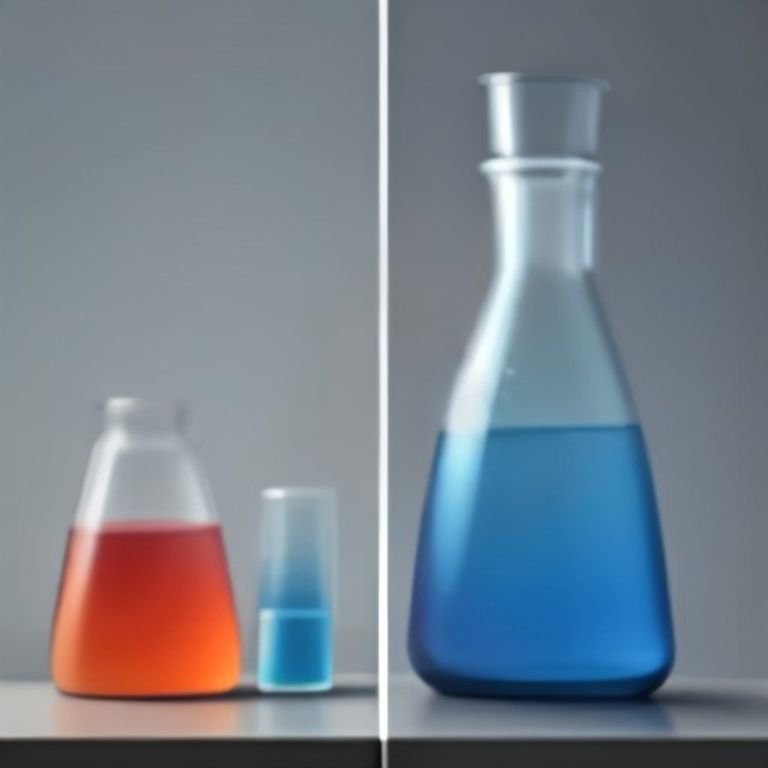
Imagine a pear-shaped flask with a long, slender neck and a single calibration mark etched around it. That’s our volumetric flask. It’s typically made of glass, sometimes plastic, and comes in various capacities (e.g., 50 mL, 100 mL, 1000 mL). What makes it special is that single mark – it signifies one, and only one, very specific volume at a specific temperature, usually 20°C. Think of it like a master chef’s measuring spoon, designed for exquisite accuracy when you absolutely cannot afford to be off by even a tiny bit.
The Graduated Cylinder: The Everyday Helper
Now, picture a tall, cylindrical container with a spout for pouring and multiple calibration marks along its side. This is your graduated cylinder. Unlike the volumetric flask, it has a range of markings, allowing you to measure various volumes. It’s the workhorse of the lab, versatile and robust. If the volumetric flask is a master chef’s tool, the graduated cylinder is like your everyday kitchen measuring cup – good for most tasks where you need a reasonably accurate measurement, but perhaps not milligram-level precision.
The Core Difference: Precision vs. Practicality
The fundamental difference between a volumetric flask and a graduated cylinder boils down to their design philosophy: absolute precision for the volumetric flask versus practical, approximate measurement for the graduated cylinder. Why does this matter? Well, consider making a delicate cake that requires exactly 100.00 mL of a certain essence. You wouldn’t use a general measuring cup, right? You’d use a tool calibrated for that exact volume. That’s the volumetric flask.
On the other hand, if you’re just measuring out 100 mL of water to boil pasta, a regular measuring cup (or in the lab, a graduated cylinder) is perfectly fine. A slight deviation won’t ruin your meal. This distinction is crucial in laboratory settings. When you need to prepare a standard solution for analytical chemistry – meaning a solution of precisely known concentration – the volumetric flask is your indispensable friend. Its narrow neck minimizes parallax error and allows for extremely accurate readings of the meniscus, ensuring the solution’s concentration is exact.
When to Reach for Each: Practical Applications
Knowing the purpose of volumetric flask versus graduated cylinder helps us decide when to use which tool. Here are some guidelines:
When to Use a Volumetric Flask:
- Preparing Standard Solutions: If you’re making a solution where the concentration must be known with high accuracy (e.g., for titration, calibration, or quantitative analysis), a volumetric flask is the only choice.
- Precise Dilutions: When diluting a stock solution to a specific, highly accurate concentration.
- Analytical Chemistry: Any experiment or procedure where the exact amount of reactant or product is critical. For tasks requiring even higher precision or smaller volumes, knowing about mastering pipette science is incredibly valuable, as pipettes often complement volumetric flasks for extreme accuracy.
When to Use a Graduated Cylinder:
- Measuring Approximate Volumes: For general lab work where high precision isn’t the primary concern, such as preparing reagents for qualitative tests.
- Transferring Reagents: Moving a specific volume of liquid from one container to another.
- Collecting Filtrates or Supernatants: When you need to measure the volume of a liquid after filtration or centrifugation.
- General Lab Demonstrations: Perfect for classroom settings where understanding the concept is more important than minute accuracy.
Anatomy of Accuracy: Design Matters
The design of each piece of laboratory glassware directly impacts its accuracy. A volumetric flask’s narrow neck means that a small change in volume results in a large change in the height of the liquid, making it easier to read the single calibration mark precisely. It’s calibrated “to contain” (TC) a very exact volume when filled to that mark. Graduated cylinders, with their wider diameter, are designed for quick and easy reading across a range of volumes. They are usually calibrated “to deliver” (TD) or “to contain” (TC) an approximate volume. The larger surface area of the liquid in a graduated cylinder means that any error in reading the meniscus will represent a larger error in the measured volume compared to a volumetric flask.
Conclusion: Choosing Your Weapon Wisely
So, what’s the takeaway from our volumetric flask vs graduated cylinder showdown? It’s not about one being inherently “better” than the other, but rather about understanding their specific strengths and weaknesses. The volumetric flask is your go-to for tasks demanding the highest level of accuracy and precision, especially in quantitative analysis and solution preparation. The graduated cylinder, on the other hand, is the versatile workhorse for general laboratory tasks where a reasonable approximation is sufficient. By choosing the right tool for the right job, you ensure the integrity of your experimental results and maintain high standards in your laboratory practice. Always remember: precision measurement is a cornerstone of good science!
FAQ: Your Questions Answered
Q: Can I use a graduated cylinder to prepare a standard solution?
A: Generally, no. While a graduated cylinder provides a reasonably accurate volume, it lacks the precision required for preparing standard solutions where the concentration must be known to several significant figures. Always use a volumetric flask for this purpose.
Q: Why is the neck of a volumetric flask so narrow?
A: The narrow neck of a volumetric flask is crucial for its high accuracy. It minimizes the surface area of the liquid at the calibration mark, which significantly reduces parallax error (errors caused by reading the meniscus from an angle) and allows for a more precise reading of the exact volume.
Q: What does “accuracy” mean in the context of laboratory glassware?
A: In laboratory glassware, accuracy refers to how close a measured value is to the true value. A volumetric flask is highly accurate because it is calibrated to contain a very specific volume. Precision, on the other hand, refers to the reproducibility of measurements. Both are vital for reliable scientific work.