

Your Essential Guide to Types of Burette: From Manual to Digital for Perfect Titrations

In the fascinating world of chemistry, precision is often the key to unlocking accurate results. Think about baking, where a little too much or too little of an ingredient can completely change the outcome. In the lab, it’s even more critical! When we talk about accurately measuring and dispensing liquids, especially in processes like titration, one piece of laboratory glassware stands out: the burette.
You might have seen them – those long, slender glass tubes with markings and a tap at the bottom. But did you know there are different kinds? And that choosing the right one can significantly impact your experiments? In this guide, we’ll explore the various types of burette, their unique uses, and help you understand how to pick the perfect one for your specific needs, whether you’re a student or a seasoned chemist.
What Exactly Is a Burette? A Primer on Precision
Before we dive into the different types, let’s quickly recap what a burette is and why it’s so important. Imagine you have a very precise faucet that can dispense liquid drop by drop, and you can instantly know the exact volume you’ve let out. That’s essentially what a burette does! It’s a laboratory tool designed to dispense variable, measured amounts of a liquid reagent in processes like titration and volumetric analysis. Its primary function is to deliver a precisely known volume of liquid, typically for a reactant whose exact concentration is unknown.
The beauty of a burette lies in its ability to give us incredibly accurate readings, often down to 0.05 mL, making it indispensable for quantitative chemical analysis. We rely on them heavily for experiments that demand exact volumes to determine concentrations or properties of substances.
The Core Types of Burette: Manual vs. Digital
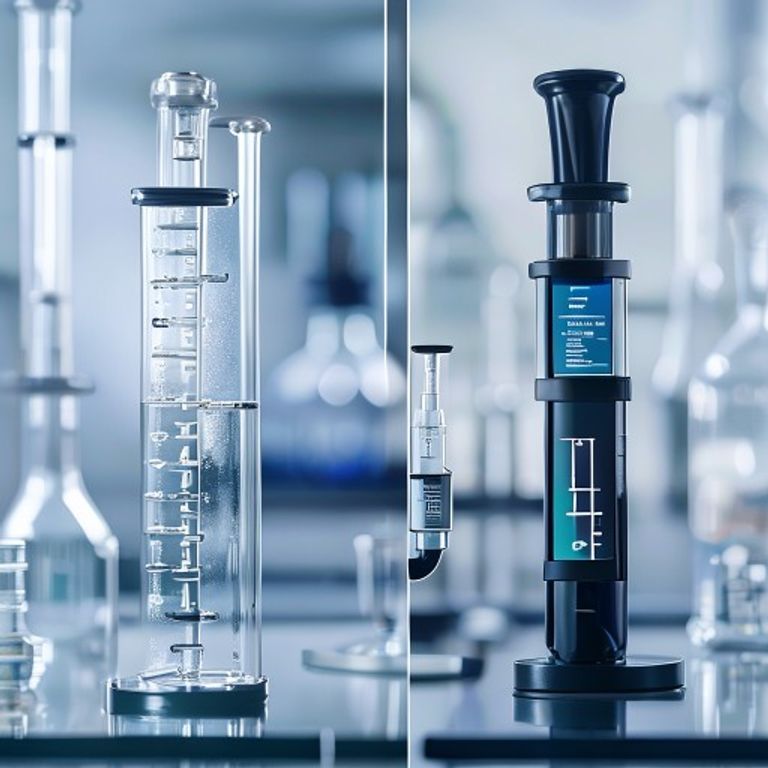
When we talk about the major types of burettes in chemistry, the most common distinction we make is between manual and digital versions. Each has its own set of advantages and ideal applications.
1. Manual Burettes (The Classic Glass Burette)
These are the traditional burettes you’re probably most familiar with. They consist of a long, calibrated glass tube with a stopcock (a valve) at the bottom to control the flow of liquid. We fill them from the top and read the volume dispensed by noting the initial and final liquid levels.
- How they work: We fill the burette with our reagent, ensuring no air bubbles are present. We then carefully open the stopcock, allowing the liquid to flow out slowly, often drop by drop, until our reaction (like a color change in a titration) is complete. The volume dispensed is then read from the graduations on the glass tube.
-
Pros:
- Cost-effective and durable (if handled carefully!).
- No power source needed, making them versatile in any lab setting.
- Familiar and easy to understand for basic operations.
- Excellent for specific applications like acid-base reactions where visual cues are important.
-
Cons:
- Relies on the user’s careful reading, which can lead to parallax error (reading the meniscus from the wrong angle).
- Slower for repetitive tasks compared to digital versions.
- Requires more skill and practice to achieve high precision consistently.
- Manual reading can be tedious for high-throughput work.
2. Digital Burettes (Automatic/Electronic Burettes)
Stepping into the modern era, digital burettes offer a leap in convenience and precision. These devices use a motor-driven piston or a similar mechanism to dispense liquids, and the volume dispensed is shown on an electronic display.
- How they work: Instead of a glass tube, digital burettes often have a reservoir (bottle) attached. The liquid is drawn directly from the reservoir into the burette’s dispensing chamber, and a precise amount is then dispensed via a controlled piston. The volume is displayed numerically, eliminating the need for manual reading.
-
Pros:
- Exceptional accuracy and reproducibility, minimizing human error.
- Fast and efficient, especially for repetitive titrations.
- Easy to use, even for beginners, as readings are unambiguous.
- Some models offer advanced features like titration speed control and data storage.
- Ideal for high-precision chemical analysis where consistency is paramount.
-
Cons:
- Significantly more expensive than manual burettes.
- Requires batteries or a power source.
- Can be more complex to calibrate and maintain.
- May not be suitable for all types of solvents due to material compatibility.
Exploring Different Kinds of Burettes and Their Uses
Beyond the manual vs. digital divide, there are also specialized designs catering to different needs. For instance, some standard laboratory burettes are specifically designed for acid-base titrations due to their excellent chemical resistance.
- Microburettes: As the name suggests, these are smaller versions designed for dispensing very small volumes (e.g., 0.1 mL to 10 mL) with extreme precision. They are crucial in micro-scale chemistry or when dealing with expensive reagents.
- Piston Burettes: While often associated with digital burettes, some manual versions also use a piston mechanism for dispensing. They offer good precision and are typically used when liquids need to be dispensed with minimal exposure to air.
- Automatic Burettes with Reservoir: Similar to digital ones in concept, these manual versions are designed to be continuously refilled from an attached reagent bottle, making them convenient for repeated titrations without constant manual refilling from a separate container.
Speaking of precise liquid handling, while burettes are excellent for dispensing variable volumes, other tools are crucial for delivering fixed, precise volumes. If you’re curious to dive deeper into another essential lab tool for precise liquid delivery, you might find our guide on essential pipette uses in every modern lab very insightful.
How to Choose a Burette for Titration (and Beyond!)
So, with all these options, how do you make the right choice? It’s not just about picking the fanciest one; it’s about matching the tool to your task. Here’s what we consider:
- Precision Requirements: For routine, less critical titrations, a manual burette might suffice. But for highly accurate chemical analysis or research-level work, a digital burette often provides the necessary precision and eliminates human reading errors.
- Volume Range: What volume of liquid will you typically be dispensing? Standard burettes (25 mL or 50 mL) are common, but if you’re working with very small samples, a microburette is a must.
- Budget: Manual burettes are significantly cheaper upfront. Digital models require a larger initial investment but can save time and reduce reagent waste in the long run.
- Frequency of Use: If you perform many titrations daily, the speed and ease of a digital burette will be a huge advantage. For occasional use, a manual one is perfectly fine.
- Chemical Compatibility: Most standard glass burettes are suitable for a wide range of chemicals. However, for highly corrosive or specific organic solvents, always check the stopcock material (Teflon vs. glass) or consider specialized burettes.
Conclusion: The Right Burette for the Right Job
Understanding the different types of burette is more than just academic knowledge; it’s a practical skill that empowers you to conduct better, more accurate experiments. Whether you opt for the tried-and-true manual glass burette or the high-tech digital version, knowing their strengths and limitations ensures that your precision measurements are always on point. The goal is always the same: to achieve reliable results with confidence. By carefully considering your specific needs, you can choose the perfect burette that will become an invaluable asset in your chemistry endeavors!
FAQ About Burettes
Q1: What is the main difference between a burette and a pipette?
While both are used for precise liquid measurement, a burette dispenses variable, measured volumes of liquid, making it ideal for titrations where you need to add liquid until a reaction endpoint is reached. A pipette, on the other hand, is designed to deliver a fixed, precise volume of liquid (e.g., 10 mL, 25 mL) and is typically used for transferring known amounts of solutions.
Q2: How do you read a manual burette accurately?
To read a manual burette accurately, always read the bottom of the meniscus (the curved surface of the liquid) at eye level to avoid parallax error. Ensure the burette is perfectly vertical. Most burettes are read from top to bottom (0 at the top), so you subtract the final reading from the initial reading to get the volume dispensed.
Q3: Why is precision important in titration?
Precision is crucial in titration because the goal is to determine the exact concentration of an unknown solution. Even small errors in volume measurement can lead to significant inaccuracies in the calculated concentration, affecting the reliability and validity of your experimental results and subsequent conclusions.
Q4: Can digital burettes be used for all chemicals?
While digital burettes offer great versatility, it’s essential to check the chemical compatibility of the materials used in the burette (e.g., piston, tubing, seals) with the specific reagents you intend to use. Some strong acids, bases, or organic solvents might react with or damage certain plastic components, so always consult the manufacturer’s guidelines.