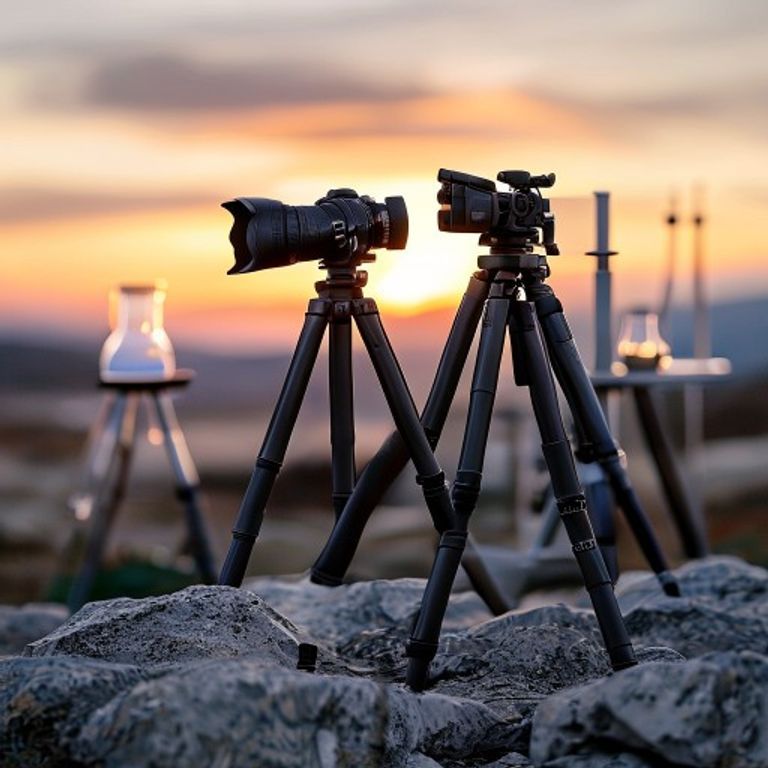
La Science du Stillness : Unlocking Peak Performance avec Tripod Science

Vous êtes-vous déjà demandé pourquoi certaines photos semblent incroyablement pointues, alors que d'autres, malgré une main stable, deviennent un peu floues ? Ou peut-être avez-vous vu des scientifiques méticuleusement installer du matériel dans un laboratoire, impliquant souvent ces stands à trois pattes familiers. Le secret des deux scénarios réside souvent dans quelque chose que l'on appelle la "science tripod". Il ne s'agit pas seulement d'avoir un trépied; il s'agit de comprendre la principes scientifiques qui permettent aux trépieds de révolutionner la précision et la stabilité de la recherche scientifique et des applications quotidiennes comme la photographie.
Pour nous photographes, un trépied est un outil fondamental pour réaliser des images nettes et détaillées, en particulier à faible lumière ou avec de longues expositions. Mais c'est plus qu'un simple stand ; c'est une merveille d'ingénierie conçue pour combattre l'ennemi invisible de la netteté : les vibrations. Dans le laboratoire, son rôle est tout aussi critique, fournissant la base inébranlable nécessaire pour des mesures précises et des expériences sûres. Aujourd'hui, nous allons plonger profondément dans le monde fascinant de la science trépied, explorant comment ces héros méconnus fonctionnent, ce qui les rend stables, et comment nous pouvons maximiser leur potentiel.
Qu'est-ce que c'est exactement ?
Au cœur, la « science trépied » désigne l'application des principes de physique, de science matérielle et d'ingénierie à la conception, à la compréhension et à l'optimisation des capacités d'amortissement de la stabilité et des vibrations d'une structure de support à trois pattes. Que nous parlions d'un trépied photo lourd ou d'un simple stand de laboratoire, l'objectif est toujours le même : créer une plate-forme stable et immobile pour tout équipement qui y repose. Il s'agit de minimiser le mouvement, grand ou petit, pour assurer la clarté, la précision et la cohérence de notre travail.
La physique derrière les coups de feu (et les expériences)
Pensez à un trépied comme une machine simple, une merveille de stabilité. Sa conception est intrinsèquement stable car trois points définissent un plan. Cela signifie qu'il n'agit pas sur un terrain inégal comme une table à quatre pattes pourrait. Mais il y a plus que trois jambes.
Gravité: Centre de gravité
Un des principes scientifiques les plus cruciaux en jeu est le centre de gravité. Pour une stabilité maximale, nous voulons que le centre de gravité combiné de notre équipement et du trépied soit aussi bas que possible et centré directement sur la base du trépied. Imaginez essayer de basculer sur une pyramide par rapport à une grande tour mince; la pyramide est beaucoup plus difficile à renverser parce que son centre de gravité est bas et large. Lors de la mise en place d'une caméra, garder l'objectif et le corps de la caméra directement au-dessus de la colonne centrale du trépied (ou encore mieux, légèrement en avant) aide à atteindre cet objectif.
Lutter contre les jiggles : la vibration arnaque
C'est là que les choses deviennent vraiment intéressantes. Les vibrations peuvent venir de n'importe où : vent, pas, l'appareil photo, la gifle miroir, ou même tout simplement toucher le trépied. La science trépied se concentre fortement sur la façon d'atténuer ces petits mouvements. Les différents matériaux, les diamètres des jambes et les mécanismes de verrouillage jouent un rôle. Un bon trépied absorbe ces vibrations plutôt que de les transmettre à l'équipement attaché. C'est comme comment la suspension d'une voiture absorbe les bosses sur la route, empêchant un tour saccadé.
Matière: Choisir votre arme
Les matériaux utilisés dans un trépied ont un impact significatif sur ses capacités d'amortissement des vibrations et sur la stabilité globale. L'aluminium est courant, offrant un bon équilibre de la résistance et des coûts. Cependant, la fibre de carbone est souvent préférée pour des applications sérieuses. Pourquoi ? La fibre de carbone, bien qu'elle soit plus légère, présente souvent des caractéristiques d'amortissement des vibrations supérieures à celles de l'aluminium. Elle est moins sujette aux fréquences résonantes et dissipe l'énergie plus efficacement. Cela signifie que moins de "jiggle" font son chemin vers votre objectif ou appareil de laboratoire sensible.
Préparation à la réussite : techniques optimales de stabilité
Même le meilleur trépied a besoin d'une configuration appropriée pour fournir des performances de pointe. Voici quelques conseils pratiques que nous avons appris par l'expérience:
- Étendre judicieusement, pas entièrement : Tout en tentant d'étendre toutes les sections de jambes, il est souvent préférable de garder les sections les plus épaisses et les sections les plus minces rétractées si possible. Les sections plus épaisses des jambes sont plus sujettes à la flexion et aux vibrations. Nous essayons d'utiliser l'extension minimale nécessaire pour atteindre la hauteur souhaitée.
- La grande position : Étendre les jambes de trépied le plus large possible, dans des limites pratiques, augmente significativement la base du support et abaisse le centre de gravité. Cela rend la configuration beaucoup plus difficile à frapper accidentellement et améliore globalement stabilité de la caméra.
- Ajouter du poids: Le booster de stabilité: Beaucoup de trépieds ont un crochet au bas de la colonne centrale. Suspendre un sac, un sac à dos ou même un sac à sable de ce crochet ajoute une pression vers le bas, augmentant la stabilité et réduction des vibrationsFaites attention de ne pas faire le trépied.
- Mind the Environment : Sur le sol mou, presser fermement les pieds trépieds dans la terre peut empêcher le déplacement. Sur les surfaces glissantes, les pieds en caoutchouc sont votre ami.
L'énigme de la résonance : comprendre les vibrations
Vous avez entendu parler d'un chanteur qui a cassé un verre de vin de leur voix ? C'est de la résonance. Chaque objet a des fréquences naturelles auxquelles il préfère vibrer. Si une vibration externe correspond à une de ces vibrations fréquences de résonance dans les applications trépieds, l'objet peut vibrer violemment. Pour nous, cela signifie des photos floues ou des lectures inexactes. Une bonne conception de trépied minimise les chances de frapper ces fréquences problématiques. C'est pourquoi les matériaux robustes de construction et d'amortissement sont si cruciaux. Notre objectif est de veiller à ce que le trépied reste un gardien silencieux et inébranlable de notre appareil photo ou de nos instruments, en empêchant tout flou de la lentille provoqué par des mouvements subtils.
Au-delà de la photographie: trépieds dans le laboratoire
Alors que nous pensons souvent aux trépieds pour la photographie, leur rôle dans les laboratoires scientifiques est tout aussi vital. Du support des appareils de chauffage lors des expériences à la fixation de capteurs délicats à une hauteur précise, les principes de maîtriser votre trépied de laboratoire pour des expériences sûres et efficaces sont tout aussi critiques. La stabilité assure des mesures précises, prévient les déversements et protège les équipements sensibles. Une position agitée dans un laboratoire de chimie n'est pas juste un inconvénient; cela peut être un danger pour la sécurité.
Conclusion
Donc, la prochaine fois que vous mettez en place votre appareil photo ou observez une expérience de laboratoire, prenez un moment pour apprécier la « science tripod » en jeu. C'est un témoignage de principes d'ingénierie simples mais profonds qui nous permettent d'atteindre une précision et une clarté incroyables. En comprenant la physique de la stabilité, de l'amortissement des vibrations et des techniques de configuration optimales, nous pouvons transformer un simple support à trois pattes en une puissance de support stable, assurant notre qualité d'image demeure toujours élevé et nos efforts scientifiques sont toujours construits sur une base solide. Il s'agit de créer ce moment parfait de calme, faisant travailler les forces invisibles de la nature pour nous.
FAQ
Q1: Pourquoi la fibre de carbone est-elle généralement meilleure que l'aluminium pour les trépieds?
La fibre de carbone, bien que souvent plus légère, offre généralement des caractéristiques d'amortissement des vibrations supérieures à celles de l'aluminium. Il est mieux à absorber et à dissiper les vibrations indésirables, conduisant à des plates-formes plus stables et des images plus nettes, en particulier pendant les longues expositions.
Q2: Puis-je utiliser n'importe quel trépied pour les appareils photo lourds?
Non, tous les trépieds ne sont pas égaux. Les trépieds ont une capacité de charge maximale, et le dépassement peut compromettre la stabilité et potentiellement endommager votre équipement. Vérifiez toujours les spécifications du fabricant et choisissez un trépied qui peut supporter confortablement au moins 1,5 à 2 fois le poids de votre appareil photo et de votre lentille.
Q3: Comment le vent affecte-t-il la stabilité du trépied?
Le vent peut avoir un impact significatif sur la stabilité des trépieds, en particulier avec des trépieds légers ou de grandes configurations de caméras en forme de voile. Les vents forts peuvent induire des vibrations et même faire basculer le trépied. Pour lutter contre cela, écartez les jambes, ajoutez du poids au crochet de la colonne centrale, et envisagez d'utiliser un obturateur à distance pour éviter de toucher la caméra.