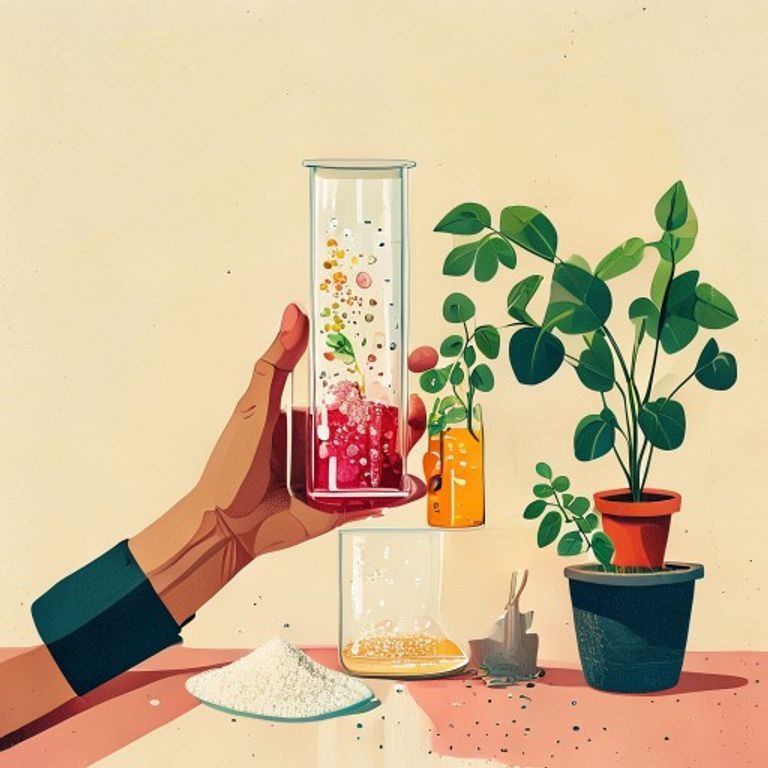
Basic Chemistry Made Simple: Introductory Lessons, Easy Experiments, and the Fundamentals You Need

Introduction
Welcome! If you’ve ever wondered what makes a soda fizz or why metal rusts, you’re in the right place. In this article we’ll walk through the very basics of chemistry in a friendly, first‑person style—think of it as a chat over a cup of coffee. We’ll cover introductory chemistry lessons for beginners, share a couple of easy chemistry experiments for high school students, and break down the fundamentals of chemical bonding. By the end, you’ll have a solid grasp of simple chemistry concepts explained in plain language.
1. Atoms, Molecules, and the Periodic Table
Everything around us is made of atoms—tiny building blocks that combine to form molecules. Imagine atoms as LEGO bricks; each brick has a specific shape (its electron configuration) that determines how it can connect with others. The periodic table is like the instruction booklet that tells you which bricks fit together and why.
- Elements: Pure substances made of one type of atom (e.g., hydrogen, carbon).
- Compounds: Molecules formed when two or more different atoms bond (e.g., water H₂O).
- Groups & Periods: Columns (groups) share similar chemical properties, while rows (periods) show trends in atomic size and reactivity.
Understanding the layout of the periodic table helps you predict how atoms will behave in a reaction—just like knowing which LEGO pieces have studs on top and which have tubes underneath.
2. Simple Chemical Bonding for Novices
Atoms love to reach a stable electron configuration, often resembling the nearest noble gas. They achieve this by sharing, giving, or taking electrons:
- Ionic bonds: One atom donates an electron to another, creating oppositely charged ions that attract (think of a magnet).
- Covalent bonds: Atoms share electrons, forming a stable partnership (like two friends sharing a pizza).
- Metallic bonds: A sea of delocalized electrons moves freely among metal atoms, giving metals their conductivity and malleability.
These bonding types explain why table salt (NaCl) dissolves in water while sugar (C₁₂H₂₂O₁₁) forms a different solution.
3. States of Matter and Simple Chemical Reactions
Matter exists in solid, liquid, and gas states. Changing from one state to another—melting, evaporating, condensing—doesn’t alter the chemical identity, just the arrangement of particles. In a chemical reaction, the actual atoms are rearranged, creating new substances.
A classic beginner reaction is the combination of vinegar (acetic acid) and baking soda (sodium bicarbonate):
CH₃COOH + NaHCO₃ → CH₃COONa + H₂O + CO₂↑
The fizz you see is carbon dioxide gas escaping—perfect for a classroom demonstration.
4. Easy Chemistry Experiments for High School Students
Hands‑on activities cement (pun intended) the concepts above. Here are two safe, low‑cost experiments you can try at home or in a school lab:
4.1. The Rainbow Test Tube
Materials: test tubes, water, food coloring, sugar.
Steps:
- Fill a test tube with water.
- Add a few drops of food coloring.
- Slowly add a spoonful of sugar and watch the solution become denser, forming layers.
This illustrates density differences and the essential role of test tubes in observing subtle changes.
4.2. DIY pH Indicator with Red Cabbage
Materials: red cabbage, blender, filter paper, small containers, household acids/bases (lemon juice, baking soda solution).
Steps:
- Blend cabbage leaves with water and filter to obtain a purple liquid.
- Place a few drops of the extract into separate containers.
- Add different solutions; observe color changes from red (acidic) to green (basic).
This experiment shows how chemical equations can be visualized through color shifts.
5. Practical Tips for Lab Safety and Equipment Care
Even simple experiments require basic safety habits. Always wear goggles, gloves, and work in a well‑ventilated area. When handling glassware, treat it gently—sudden temperature changes can cause breakage.
If you’re curious about other lab tools, check out the guide on what is a beaker. Knowing the right size and proper cleaning methods extends the life of your equipment and keeps results reliable.
Conclusion
Basic chemistry doesn’t have to be intimidating. By visualizing atoms as LEGO bricks, mastering simple bonding ideas, and trying a few hands‑on experiments, you’ll quickly move from “what’s that?” to “I get it!” Remember, the best way to learn is by doing—so grab a test tube, a beaker, and start exploring the invisible world that makes up everything around you.
FAQ
Q: Do I need a full laboratory to start learning basic chemistry?
A: No. Many introductory concepts can be demonstrated with household items and a few inexpensive pieces of glassware like test tubes and beakers.
Q: How can I remember the periodic table groups?
A: Think of groups as “families.” Elements in the same column share similar traits—just like siblings often look alike.
Q: What’s the safest way to dispose of chemicals after an experiment?
A: Neutralize acids and bases with the opposite (e.g., vinegar for baking soda), then dilute with plenty of water before pouring down the drain. Always follow local regulations.
Q: Can I use the same experiment for both middle and high school students?
A: Absolutely. Adjust the depth of explanation: younger students focus on observation, while older students can write balanced chemical equations.
Q: Where can I find more detailed lab equipment guides?
A: Our site offers several in‑depth articles, such as the essential role of test tubes for everyday lab work.