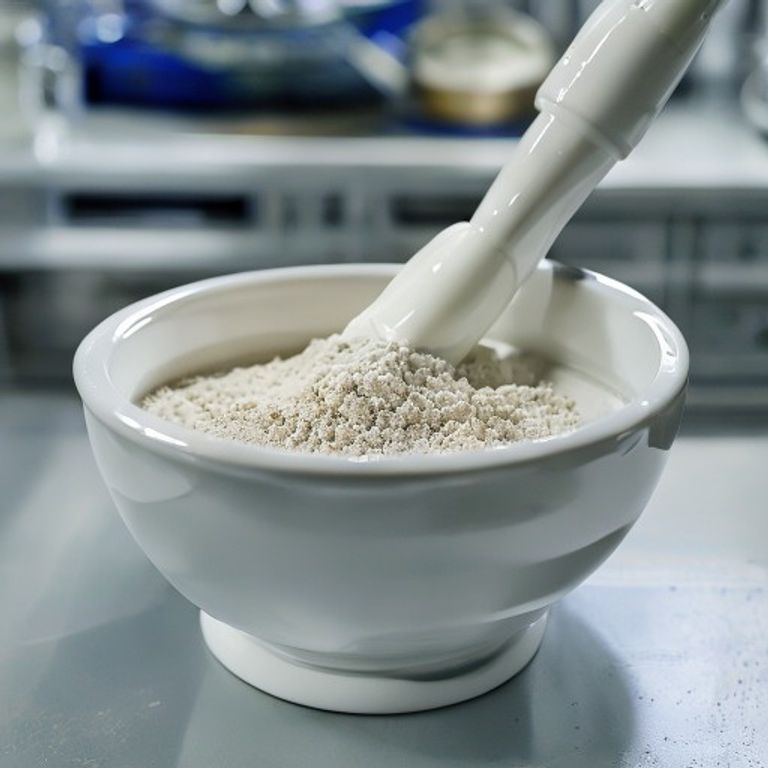
Unlocking the Power of Precision: Your Ultimate Guide to the Laboratory Mortar and Pestle

Hello, fellow science enthusiasts! Have you ever wondered how solid samples in the lab are transformed into fine powders, ready for analysis or reaction? Or how those tiny pills you sometimes need to crush become a manageable paste? Often, the answer lies with a simple yet incredibly powerful tool: the laboratory mortar and pestle. Despite its ancient origins, this duo remains an unsung hero on countless lab benches.
For us in the world of chemistry, having the ability to precisely grind, mix, and pulverize solid materials is absolutely crucial. From preparing samples for spectroscopic analysis to creating homogeneous mixtures for reactions, the mortar and pestle is our go-to tool. Let’s dive deep into understanding this fundamental piece of equipment, mastering its use, and appreciating its indispensable role in our daily lab work.
The Unsung Hero: Why We Need a Mortar and Pestle in Chemistry Labs
When we talk about uses of mortar and pestle in chemistry labs, the list is surprisingly extensive. At its core, this tool is designed for comminution – the reduction of solid particles to a smaller size – and trituration – the grinding of a solid to a fine powder or intimately mixing solid ingredients. Think of it like a miniature, manual rock crusher, but with much more finesse!
- Sample Preparation: This is arguably its primary role. Before we can analyze a solid sample (be it a mineral, a pharmaceutical tablet, or a plant extract), it often needs to be homogenized and reduced in particle size. This increases the surface area, ensuring better dissolution or more efficient extraction.
- Increasing Reaction Rates: Finer particles mean more surface area exposed, which can significantly speed up chemical reactions. If we’re working with a solid reactant, grinding it down can make a huge difference.
- Creating Homogeneous Mixtures: Imagine needing to mix two different solid powders perfectly. The mortar and pestle allows us to physically blend them into a uniform mixture, ensuring consistency in our experiments.
- Preparing Pastes and Suspensions: Sometimes, we need to add a small amount of liquid to a solid to form a paste or suspension. The mortar and pestle is excellent for this, ensuring even dispersion.
Essentially, whenever we need to change the physical form of a solid to enhance its chemical or physical properties for further analysis, the mortar and pestle comes to our rescue. It’s truly vital for effective sample preparation.
Mastering the Grind: Proper Techniques for Precision
Knowing how to properly use a mortar and pestle in analytical chemistry isn’t just about crushing; it’s an art. The goal isn’t just to make things smaller, but to do so efficiently, safely, and without contaminating our precious samples. Here are some key grinding techniques for chemical samples with mortar and pestle:
- Start Small: Always begin with a small amount of sample. Overloading the mortar makes grinding inefficient and can cause material to spill.
- Crush, Don’t Pound: Rather than just pounding straight down, we should use a combination of crushing and shearing motions. Apply firm, controlled pressure with the pestle, rotating it around the mortar’s interior. Think of it like a gentle circular massage for your sample, gradually breaking it down.
- Scrape and Repeat: Periodically, use a spatula to scrape down any material clinging to the sides of the mortar or pestle. This ensures all particles are subjected to grinding and helps maintain homogeneity.
- Particle Size Matters: Continue grinding until the desired particle size is achieved. For analytical work, this often means a very fine, uniform powder.
- Cleanliness is Key: Before and after each use, thoroughly clean the mortar and pestle to prevent cross-contamination. Use appropriate solvents if necessary, and ensure it’s completely dry.
Remember, patience and a steady hand are our best friends here. Rushing the process can lead to uneven grinding or even damage to the equipment.
More Than Just Rock: Choosing the Right Mortar and Pestle Material
Just like we have different types of beakers in the lab for different purposes, mortars and pestles also come in various materials, each with its own advantages. Choosing the right mortar and pestle material for chemical reactions and sample preparation is crucial for success.
- Porcelain: This is perhaps the most common type. Porcelain mortars and pestles are robust, relatively inexpensive, and suitable for general-purpose grinding of most crystalline solids. They are somewhat porous, so cleaning thoroughly is essential, especially between different samples.
- Agate: For more demanding applications, especially in analytical chemistry where contamination must be minimized, agate is superior. It’s extremely hard, non-porous, and doesn’t abrade easily, meaning less contamination from the mortar itself. However, it’s more expensive and can be brittle if dropped. We often use agate for very hard samples or when ultra-fine grinding is required.
- Glass: Glass mortars and pestles are great when chemical inertness is paramount and staining is a concern. They are non-porous and easy to clean, but also the most fragile. They’re best for softer materials or when mixing liquids with solids.
- Alumina/Ceramic: Similar to porcelain but often harder and less porous, providing a good balance between cost and performance for many applications.
- Stainless Steel: Less common for general chemistry but used for specific applications, especially when dealing with biological samples or cryogenic grinding where extreme cold is involved. It’s durable but can react with certain chemicals.
When selecting, consider the hardness of your sample, the potential for contamination, and the chemical inertness required for your specific reaction or analysis.
The Edge We Gain: Advantages in Sample Preparation
In an age of automated lab equipment, why do we still rely on something as manual as a mortar and pestle? The advantages of using mortar and pestle for sample preparation in chemistry are quite compelling:
- Precision and Control: We have direct control over the grinding process, allowing us to achieve specific particle sizes and homogeneity that might be difficult with automated machines for very small samples.
- Cost-Effective: They are significantly cheaper than mechanical grinders and require no power, making them accessible and reliable.
- Versatility: A single mortar and pestle can handle a wide variety of samples, from soft plant materials to hard minerals, as long as the material choice is appropriate.
- Minimal Sample Loss: With careful technique, sample loss can be incredibly low, which is vital when working with precious or limited materials. After grinding, we can use tools like spatulas and perhaps even laboratory funnels to transfer the finely prepared sample efficiently without leaving much residue behind.
- No Heat Generation: Unlike high-speed mechanical grinders, manual grinding generates very little heat, which is critical for heat-sensitive compounds that could degrade otherwise.
So, while it might seem old-fashioned, the mortar and pestle offers unique benefits that modern equipment sometimes can’t replicate, especially for delicate or small-scale work.
Conclusion
From the subtle art of trituration to the robust task of pulverization, the laboratory mortar and pestle stands as a testament to the enduring power of simple, effective tools in science. It’s more than just a piece of equipment; it’s an extension of our hands, allowing us to manipulate matter at a fundamental level. By understanding its purpose, mastering its techniques, and selecting the right material, we can unlock its full potential, ensuring our experiments start with the best possible sample preparation.
Frequently Asked Questions (FAQ)
1. What is the main difference between trituration and comminution?
Comminution is the general term for reducing particle size. Trituration is a specific type of comminution that involves grinding solids to a very fine powder or intimately mixing solid ingredients, often in a mortar and pestle. All trituration is comminution, but not all comminution is trituration.
2. Can I use a kitchen mortar and pestle for lab work?
While similar in function, kitchen mortars and pestles are generally not recommended for precise lab work. They might be made of porous materials, contain dyes, or have residues that could contaminate chemical samples. Lab-grade equipment is designed for purity, inertness, and specific particle size reduction.
3. How do I clean my mortar and pestle to prevent contamination?
After each use, scrape out as much residual sample as possible. Then, wash with appropriate solvent (e.g., distilled water, ethanol, acetone) followed by a thorough rinse with distilled water. For porcelain or ceramic, a scrub brush can help. For agate, gentle wiping is usually sufficient. Always ensure it’s completely dry before storing or reusing.
4. What are some common mistakes to avoid when using a mortar and pestle?
Common mistakes include overloading the mortar, pounding instead of grinding, not cleaning properly between samples, using the wrong material for the sample’s hardness, and applying excessive force that could damage the equipment or sample.