Mastering Precipitation: Practical Tips to Control, Filter, and Recover Solids in the Lab and Industry

Introduction
Ever watched sugar crystals form in a jar of water and wondered how we can make that happen on purpose? In chemistry, that “sweet” process is called precipitation. Whether you’re trying to pull a metal out of a wastewater stream or isolate a product in a synthesis, mastering precipitation can save time, money, and headaches. In this article I’ll walk you through the basics, share hands‑on techniques, and give you practical solutions for filtering and washing your precipitates.
How to Precipitate a Chemical Reaction
Think of a precipitation reaction as a party where two soluble guests meet, exchange partners, and end up as an insoluble couple. The key steps are:
- Choose the right reagents: You need ions whose product has a low solubility product constant (Ksp).
- Control supersaturation: Adding the precipitating agent slowly creates a supersaturated solution, similar to cooling a soda so bubbles form.
- Trigger nucleation: Small “seeds” (often dust particles) act as nuclei where crystals can start growing.
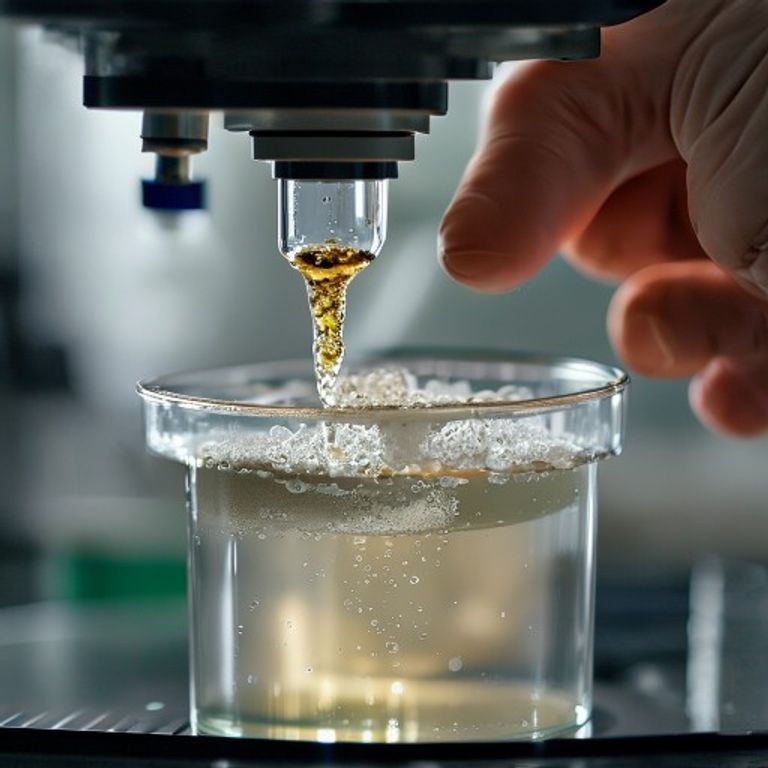
For example, to precipitate calcium carbonate you can mix calcium chloride with sodium carbonate. By adding the sodium carbonate dropwise while stirring, you keep the supersaturation moderate, which yields fine, uniform crystals instead of a clumpy mess.
Precipitation Reactions in Water Treatment
In municipal water treatment, precipitation is the workhorse for removing heavy metals, phosphates, and hardness. The process typically follows these steps:
- Adjust pH to the optimal range where the target ion’s Ksp is lowest.
- Introduce a counter‑ion (e.g., lime for phosphate removal) to form an insoluble precipitate.
- Allow sufficient time for crystal growth, then separate the solid.
Understanding the precipitation equilibrium helps you avoid over‑dosing chemicals, which can lead to excess sludge and higher disposal costs.
Lab Techniques for Precipitating Solids
In the lab, reproducibility is king. Here are some tricks I use daily:
- Temperature control: Cooling the mixture slows crystal growth, giving you larger, filter‑friendly particles.
- Stirring speed: Gentle stirring promotes uniform nucleation without breaking fragile crystals. If you need a quick reference on how to stir properly, check out choosing the right stirring rod for optimal mixing.
- Seeding: Adding a tiny amount of pre‑formed crystals can direct the shape and size of the new precipitate.
Factors Affecting Precipitate Formation Rate
Several variables act like the “weather” for your crystal garden:
| Factor | Effect on Rate |
|---|---|
| Concentration of reactants | Higher concentrations increase supersaturation → faster nucleation. |
| pH | Alters ion speciation and Ksp values. |
| Temperature | Higher temps generally increase solubility, slowing precipitation. |
| Presence of additives | Complexing agents can either inhibit or promote crystal growth. |
By tweaking these parameters you can shift the balance between rapid precipitation (good for quick removal) and controlled crystal growth (ideal for product isolation).
Methods to Filter and Wash Precipitates
Once you have your solid, the next challenge is separation and purification. Here are three reliable methods:
- Vacuum filtration: Use a Buchner funnel and filter paper; the vacuum pulls liquid through, leaving a cake of solid.
- Centrifugation: Spin at 3,000–5,000 rpm for 5–10 min; the precipitate forms a compact pellet that can be decanted.
- Decantation with a wash step: Gently pour off the supernatant, then add a small amount of cold solvent (often distilled water) to rinse away soluble impurities.
After washing, drying the precipitate at 60‑80 °C (or under a gentle stream of nitrogen) removes residual moisture without altering crystal structure.
Connecting to Supernatant Management
Every precipitation experiment leaves behind a liquid phase – the supernatant. Proper handling of this waste stream is just as important as the solid recovery. For detailed guidance on extracting and analyzing supernatants, see practical tips for extraction, handling, and analysis of supernatant. Good supernatant management reduces contamination risk and helps you comply with environmental regulations.
Conclusion
Precipitation may sound like a simple “solid out of solution” trick, but mastering it involves chemistry, physics, and a bit of art. By controlling supersaturation, temperature, and stirring, you can steer crystal size and purity. Then, choose the right filtration or centrifugation method, wash thoroughly, and don’t forget to treat the supernatant responsibly. Apply these practical tips and you’ll turn any messy reaction into a clean, reproducible process.
FAQ
Q: How do I know the Ksp of a compound?
A: Most common salts have their solubility product listed in standard chemistry handbooks or online databases. If it’s not available, you can determine it experimentally by measuring solubility at different concentrations.
Q: Can I precipitate a product at room temperature?
A: Yes, but temperature influences solubility. For heat‑sensitive compounds, keep the reaction cold to favor precipitation.
Q: What’s the best way to avoid clogging the filter paper?
A: Keep the particle size small enough to pass through the pores, or use a pre‑filter (e.g., a glass frit) before the final vacuum filtration.
Q: How many wash cycles are enough?
A: Typically 2–3 quick rinses with cold solvent remove most soluble impurities. Test the wash water for residual ions if purity is critical.
Q: Is centrifugation always better than filtration?
A: Not necessarily. Centrifugation is faster for fine powders, while filtration provides a larger surface area for washing. Choose based on your solid’s texture and the volume of liquid.