


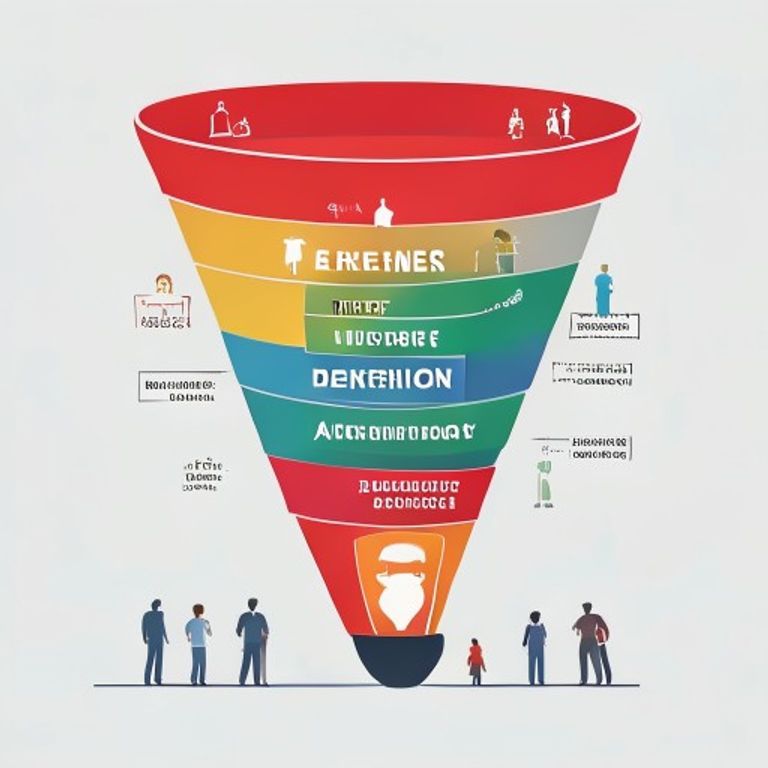
From Curiosity to Conversion: Understanding the Core Function of a Funnel for Business Growth

Have you ever wondered how businesses manage to turn a random visitor into a loyal customer? It’s not magic; it’s a meticulously designed process, often visualized as a funnel. Just like a physical funnel helps us neatly pour liquids from a wide opening into a narrow one without spills, a business funnel guides potential customers smoothly through their journey. Today, we’re going to dive deep into the function of a funnel in the business world, exploring why it’s not just a buzzword, but a vital tool for success.
Think of it this way: when you’re trying to fill a bottle with a narrow neck, you don’t just dump the liquid from a wide pitcher, right? You use a funnel. In business, our “pitcher” is the vast ocean of potential customers, and our “bottle” is the segment of those who become paying clients. The funnel ensures that this transition is efficient, measurable, and repeatable. Without it, we’d be pouring our marketing efforts everywhere, hoping something sticks, which is often a recipe for wasted resources and frustration.
The Main Function: Guiding the Customer Journey
At its heart, the mastering the marketing funnel is about systematically guiding prospects through various stages, from initial awareness to final purchase and even advocacy. When we ask what is the main function of a marketing funnel, the answer truly lies in its ability to map and streamline the customer journey. It’s a strategic roadmap that helps us understand what information or action a potential customer needs at each step to move closer to a decision. This clarity is invaluable for any business aiming for sustainable growth.
From Awareness to Action: How a Sales Funnel Converts Leads
Let’s break down how this journey typically unfolds and how does a sales funnel work to convert leads. We usually talk about a few key stages:
Top of the Funnel (TOFU): Awareness & Lead Generation
This is the widest part of our funnel, where we cast a broad net. Our goal here is lead generation – getting as many potential customers as possible to notice us. We’re not selling yet; we’re providing valuable content, solving problems, or simply piquing interest. Think blog posts, social media content, free guides, or even webinars. Here, people are just becoming aware of a problem they have and that solutions (like ours!) exist.
Middle of the Funnel (MOFU): Interest & Consideration
Once we have their attention, we move to the middle. Here, prospects are actively researching solutions. Our job is to nurture these leads, building trust and demonstrating our expertise. This might involve detailed case studies, product comparisons, or email sequences that provide more in-depth information. They’re evaluating options, and we want to position ourselves as the best choice. This is where the sales pipeline starts getting serious, as we move prospects from casual interest to genuine consideration.
Bottom of the Funnel (BOFU): Decision & Conversion
This is where the magic happens – the narrow end of the funnel. Prospects are ready to make a purchase decision. Our content here is direct and actionable: product demos, free trials, consultations, or compelling offers. The ultimate purpose of a customer journey funnel is to bring customers to this point, ensuring they feel confident and ready to convert. This stage is all about making it as easy as possible for them to say “yes!”
Why Funnels Are Important in Business Strategy
You might be thinking, “This sounds like a lot of work. Why are funnels important in business strategy?” The answer is simple: predictability and optimization. A well-defined funnel allows us to:
- Measure Performance: We can see exactly where prospects drop off, helping us identify bottlenecks.
- Optimize Conversions: By understanding drop-off points, we can tweak our strategies to improve conversion rate optimization at each stage.
- Allocate Resources Wisely: We know which marketing efforts are most effective at different stages, preventing wasted spend.
- Forecast Sales: With clear conversion rates, we can better predict future sales and growth.
- Improve Customer Experience: By providing the right information at the right time, we create a smoother, more helpful journey for our customers.
Every business, regardless of its size or industry, has some form of a funnel, even if it’s not explicitly named. However, truly understanding the role of a conversion funnel and actively managing it is what separates thriving businesses from those struggling to connect with their audience. It’s about being intentional with every interaction.
Practical Steps to Harness Your Funnel’s Power
So, how do we put this into practice? We start by mapping out our own customer journey. What are the steps a customer takes from first hearing about us to becoming a paying client? Once we have that, we can then assign specific marketing activities and content to each stage. Regularly review your funnel data – where are people getting stuck? What content performs best? This continuous analysis and adjustment is key to maximizing your funnel’s potential.
Conclusion
In essence, the function of a funnel is to provide structure, predictability, and efficiency to the chaotic world of customer acquisition. It’s our blueprint for guiding potential customers, nurturing their interest, and ultimately converting them into loyal patrons. By embracing the funnel concept and actively working on ours, we move beyond guesswork and toward a strategic, data-driven approach that fuels sustainable business growth. So, if you haven’t already, take some time to map out your own business funnel today – your future self (and your revenue) will thank you!
Frequently Asked Questions (FAQ)
Q1: Is a sales funnel the same as a marketing funnel?
While often used interchangeably, there’s a subtle difference. A marketing funnel generally covers the broader journey from awareness to interest (often lead generation), while a sales funnel typically focuses on the latter stages from consideration to purchase, managed by the sales team. However, they are deeply interconnected and ideally work hand-in-hand.
Q2: How long should my sales funnel be?
There’s no one-size-fits-all answer. The length and complexity of your funnel depend on your industry, product price point, and target audience. A simple product might have a very short funnel, while a high-value B2B service could have a funnel spanning months with many touchpoints.
Q3: Can I have multiple funnels for different products or services?
Absolutely! Many businesses find it effective to create separate funnels for different products, services, or target customer segments. This allows for highly tailored messaging and a more relevant customer experience for each specific offering.