


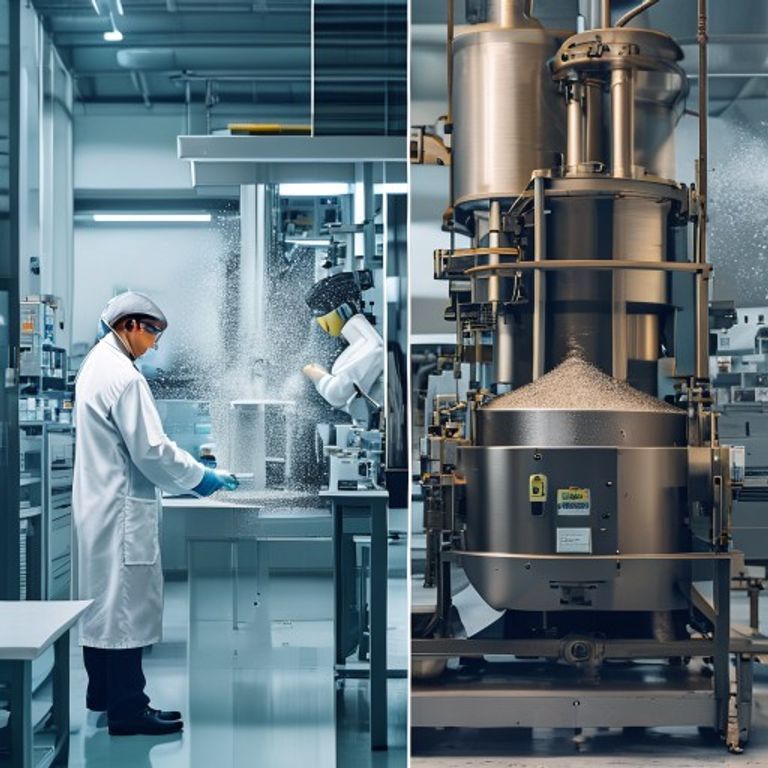
Unlocking Precision: Your Essential Guide to Chemical Grinders for Lab & Industry

Ever wondered how that super-fine powder in your medication or the precisely blended ingredient in an industrial process came to be? Chances are, a chemical grinder played a starring role. As someone deeply involved in the world of materials and processes, I can tell you that reducing substances to a finer particle size isn’t just about making them smaller; it’s about unlocking their true potential.
From accelerating chemical reactions to improving material consistency, the humble act of grinding is a foundational step in countless scientific and industrial applications. Join me as we explore the fascinating world of chemical grinders – these powerful machines that are much more than just fancy blenders.
Why Do We Need to Grind Chemicals? The Science Behind the Size
Imagine trying to dissolve a sugar cube in your coffee versus using granulated sugar. Which one dissolves faster? Granulated sugar, right? That’s because it has a much larger surface area exposed to the liquid. The same principle applies to chemicals!
- Increased Surface Area: This is perhaps the biggest reason. A larger surface area means more contact points for reactions, dissolution, or absorption, making processes more efficient and sometimes even possible.
- Improved Homogeneity: When mixing different powders, finer particles ensure a more uniform blend, preventing segregation and ensuring consistent product quality.
- Enhanced Reactivity: Many chemical reactions are surface-dependent. Grinding materials down can dramatically speed up reaction rates.
- Better Flow Properties: Fine powders tend to flow more smoothly than coarse, irregularly shaped particles, which is crucial for automated dosing and manufacturing processes.
- Sample Preparation: For analytical testing, often we need a perfectly homogeneous sample, and grinding is the first step to achieve that uniformity.
Types of Chemical Grinders: Finding Your Perfect Match
Just like you wouldn’t use a sledgehammer to crack a nut, you wouldn’t use a massive industrial pulverizer for a small lab sample. The world of equipment for grinding chemicals into fine powder is diverse, catering to a wide range of needs and scales.
Small Scale: The Lab Workhorse
When you’re working with small batches, perhaps developing a new compound or preparing samples for analysis, precision and control are key. This is where a small chemical grinding mill for laboratory use shines.
- Mortar and Pestle: The classic, manual method. It’s incredibly versatile for very small quantities and when you need precise control over the grinding force. We’ve all seen this iconic tool, probably even used it in basic chemistry classes!
- Analytical Grinders/Rotor Mills: These are electrically powered devices designed for quick, efficient grinding of small samples. They often use high-speed rotating blades or rotors to achieve fine powders rapidly. Think of them as high-tech, precision mini-blenders for your lab samples. When handling various proper names for laboratory test tubes, you’ll often prepare your samples using these handy tools first.
- Ball Mills (Lab Scale): Miniaturized versions of their industrial counterparts, these use grinding media (balls) inside a rotating jar to pulverize samples. They are excellent for achieving very fine particle sizes and for grinding hard or brittle materials.
Industrial Powerhouses: For Bulk Materials
When you need to process hundreds or thousands of kilograms of material, we turn to the big guns – the industrial chemical pulverizer for bulk materials. These machines are built for endurance, capacity, and consistent output.
- Ball Mills (Industrial): Large rotating drums filled with grinding media (balls of steel, ceramic, or rubber) that tumble and crush the material. They are workhorses for continuous operation and can handle a wide range of materials to produce fine to ultra-fine powders.
- Hammer Mills: These utilize rapidly rotating hammers to crush and pulverize materials by impact. They are particularly effective for softer to medium-hard materials and are widely used in pharmaceuticals, food processing, and chemical industries.
- Jet Mills: For achieving ultra-fine particle sizes (often in the micron or sub-micron range), jet mills are the go-to. They use high-velocity compressed air or inert gas to create collisions between particles, reducing them without any moving parts. This makes them ideal for heat-sensitive or abrasive materials.
Key Factors When Choosing Your Chemical Grinder
Selecting the best lab grinder for chemical powdering or an industrial pulverizer isn’t a one-size-fits-all decision. Here’s what I consider crucial:
- Material Properties: Is the chemical hard or soft? Sticky or brittle? Heat-sensitive or explosive? These characteristics dictate the type of grinder and its grinding mechanism.
- Desired Particle Size: Do you need a coarse powder, a fine powder, or something in the nano-range? Each grinder type excels at a particular particle size distribution.
- Capacity: How much material do you need to process per hour or per batch? This determines the size and power of the equipment.
- Safety Features: This is non-negotiable! Look for features like sealed grinding chambers, explosion-proof designs (especially for volatile chemicals), and dust containment systems.
- Cleaning and Maintenance: How easy is it to clean the grinder between batches? Cross-contamination can be a huge issue, so easy disassembly and cleaning are vital.
- Cost: From entry-level lab grinders to sophisticated industrial units, prices vary widely. Balance your budget with your performance requirements.
Safety First: Handling Your Chemical Grinder Responsibly
Working with chemicals, especially in powder form, always carries risks. Knowing how to grind chemicals into powder safely is paramount. Think of it like cooking – you wouldn’t handle hot oil without caution, right?
- Personal Protective Equipment (PPE): Always wear appropriate PPE, including safety goggles, gloves, and a lab coat. A dust mask or respirator is essential when dealing with fine powders, as inhalation can be harmful.
- Ventilation: Ensure adequate ventilation in your workspace. Many grinding processes create fine dust that can become airborne, posing health risks or even fire/explosion hazards with certain chemicals.
- Containment: Use grinders with sealed chambers or operate them within a fume hood or containment booth to minimize dust exposure.
- Cross-Contamination: Thoroughly clean your grinder between different materials. Even tiny residual particles can contaminate your next sample or batch, leading to inaccurate results or hazardous reactions.
- Read the Manual: Every piece of equipment has its quirks. Always read and understand the manufacturer’s instructions for safe operation and maintenance. Remember the importance of safe use in the lab for all your equipment.
Conclusion: Powering Progress, One Particle at a Time
Chemical grinders might not be the flashiest equipment in the lab or factory, but their role is undeniably critical. They are the unsung heroes that transform raw materials into usable forms, enabling everything from groundbreaking scientific discoveries to the production of everyday essentials. By understanding the types, applications, and safety considerations of these remarkable machines, we can harness their power responsibly and efficiently, pushing the boundaries of what’s possible in chemistry and beyond. So, the next time you see a fine powder, give a silent nod to the incredible technology that made it happen!
FAQ: Your Chemical Grinder Questions Answered
Q1: What’s the main difference between a chemical grinder and a pulverizer?
A1: Often, these terms are used interchangeably! However, “grinder” is a broader term for any device that reduces particle size. “Pulverizer” typically implies reducing material to a very fine powder. You might say all pulverizers are grinders, but not all grinders are pulverizers. It mostly comes down to the fineness of the end product.
Q2: Can I use a regular kitchen blender or coffee grinder for chemicals?
A2: Absolutely NOT, unless specifically designed and certified for chemical use. Kitchen appliances are not built for the unique properties of chemicals (corrosive, toxic, explosive, heat-sensitive) and lack the necessary safety features like sealed chambers or explosion-proof motors. Using them can be extremely dangerous and lead to contamination, equipment damage, or serious accidents.
Q3: How do I ensure my chemical grinder is clean between different samples?
A3: Thorough cleaning is vital. This usually involves disassembling the grinding chamber, cleaning parts with appropriate solvents (if compatible with the material), brushing away residual particles, and then drying completely. Some grinders have self-cleaning features or interchangeable grinding chambers to minimize cross-contamination risks.
Q4: What are the most important safety precautions when operating a chemical grinder?
A4: Always wear appropriate PPE (eye protection, gloves, mask/respirator), ensure good ventilation, and understand the specific hazards of the chemical you are grinding (e.g., flammability, toxicity, dust explosibility). Never overload the grinder, and always follow the manufacturer’s operating instructions. Safety should always be your top priority!







